
Best Automotive & EV Multimeters: Safe Testing Guide
The best automotive multimeter is a True RMS meter with millivolt resolution, a 10–20 A current input, duty cycle and temperature. For hybrid and electric vehicles, you also need a meter and leads rated at least CAT III 1000 V, an insulation tester for HV cables and motors, and the right PPE and training. This guide explains what each job requires, compares popular meters by their published specs, and gives a step-by-step safe testing routine for 12 V and high-voltage systems.
What each automotive job needs from a meter
| Job | Functions you need | Minimum safety | Typical tool kit |
|---|---|---|---|
| 12 V / 24 V cars, trucks, generators | DC volts, mV voltage drop, current to 10–20 A, resistance, continuity, duty cycle, frequency, temperature, MIN/MAX | CAT II/III meter is enough for the vehicle itself | True RMS multimeter + DC clamp meter |
| Hybrid and EV high-voltage circuits (about 200–800 V DC) | DC volts to 1000 V, low-pass filter on inverter/motor circuits, insulation resistance, low-resistance bonding | CAT III 1000 V meter and leads, insulated tools, HV gloves, OEM procedure | CAT III 1000 V multimeter + insulation tester / EV tester |
| EV charging points (AC wallbox and DC chargers) | AC/DC volts, current, earth continuity, insulation | CAT III 1000 V / CAT IV 600 V depending on supply point | Multimeter + clamp meter + insulation tester |
12 V and 24 V vehicle testing
Most diagnostic work on conventional cars, trucks and generators happens on 12 V or 24 V DC. The voltages are low, but the currents are high and the signals are fast. A good automotive meter should have:
- DC millivolts to measure voltage drop across cables, earth straps and connectors under load
- A fused 10 A or 20 A input for parasitic drain and small motor currents, plus mA and µA ranges for sleep current
- Duty cycle and frequency for PWM fuel pumps, solenoids, injectors and sensors
- Temperature with a Type-K probe for coolant, A/C lines and exhaust
- MIN/MAX to capture the lowest battery voltage during cranking
- True RMS so AC readings stay correct on alternator ripple and electronic loads
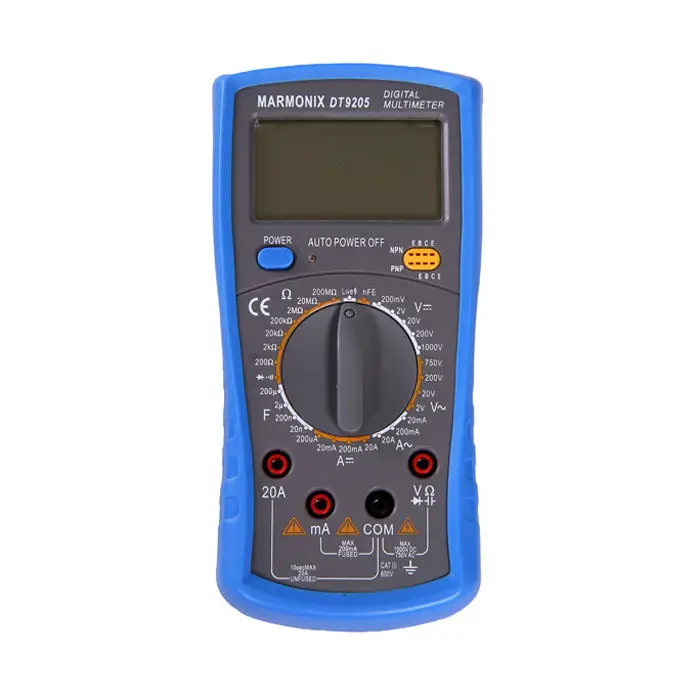
The Marmonix MMU-112 has all of these: 6000 counts, DC and AC current from 600 µA to 20 A, frequency to 9.999 MHz, duty cycle 1–99% and temperature from −20 to 1000 °C. The MVC 97 (4000 counts, 10 A, NCV) and the DT-9205 (20 A, hFE) are budget alternatives. For starter motor, alternator output and battery cable current, a DC clamp meter such as the MCA-212 clamp meter (1200 A AC/DC) or the MCA-206 (600 A AC/DC) measures without breaking the circuit.

Hybrid and EV high-voltage safety
Hybrid and electric vehicles use high-voltage DC battery packs, commonly in 400 V and 800 V class systems, feeding inverters, motors, DC-DC converters and electric A/C compressors. A fault can deliver a lethal shock or an arc flash. Before touching any HV component:
- Meter and leads: rated at least CAT III 1000 V, with shrouded plugs and finger guards, and leads in good condition
- PPE: insulated gloves rated for the system voltage (inspected before every use), safety glasses or face shield, and insulated tools
- Training and procedure: only trained, authorised technicians, following the vehicle maker’s de-energising steps and lock-out procedure
- Insulation testing: use an insulation tester on de-energised components at the test voltage the vehicle maker specifies
Insulation and bonding checks are where many workshops are under-equipped. UN ECE R100 sets a minimum isolation resistance of 100 Ω per volt for DC circuits and 500 Ω per volt for AC circuits, so a 400 V DC system needs at least 40 kΩ, and real healthy insulation reads far higher. The MIR-1000 insulation tester tests at 100, 250, 500 and 1000 V up to about 5.5 GΩ and also measures continuity, which suits HV cable, motor and charger checks on isolated parts. Read how to test insulation resistance step by step for the method.
Spec comparison: automotive and EV test meters
Figures are from each maker’s published specifications at the time of writing; “—” means not stated on the page we checked.
| Meter | Type | Counts / accuracy | Voltage / current / insulation | Safety rating | Notes |
|---|---|---|---|---|---|
| Fluke 87V | Multimeter | 6000 / 20,000 counts, ±(0.05%+1) DC | 1000 V, 10 A (20 A for 30 s) | CAT III 1000 V / CAT IV 600 V | Low-pass filter for drives; widely used for hybrid/EV |
| Fluke 88V | Automotive multimeter | 6000 counts, 0.1% DC | 1000 V, 10 A (20 A for 30 s) | CAT III 1000 V / CAT IV 600 V | RPM (inductive), duty cycle, pulse width (ms), peak capture 250 µs |
| Fluke 1587 FC | Insulation multimeter | ±(0.09%+2) DC | 1000 V; insulation 50–1000 V, 0.01 MΩ–2 GΩ | CAT III 1000 V / CAT IV 600 V | PI/DAR, live-circuit detect >30 V, low-pass filter |
| Power Probe PPEVTEST | EV test meter | True RMS | 1000 V; insulation 1 kV to 200 GΩ | CAT III 1000 V / CAT IV 600 V | 4-wire milliohm from 0.001 mΩ, PI/DAR, Bluetooth, ECE-R100 |
| Megger EVT100 | EV multifunction tester | — | Insulation 50–1000 V to 200 GΩ | CAT III 600 V | 4-wire low resistance, continuity, diode, 256 results |
| Marmonix MMU-112 | Multimeter | 6000 counts, ±(0.5%+3) DC | 1000 V DC / 750 V AC, 600 µA–20 A | CAT IV 600 V | Duty cycle, 9.999 MHz, −20 to 1000 °C, MAX/MIN |
| MCA-212 clamp meter | Clamp meter | 6000 counts | 1200 A AC/DC, 1000 V DC | CAT IV 600 V | DC clamp current for starter, alternator and battery cables |
| MIR-1000 insulation tester | Insulation tester | — | 100 / 250 / 500 / 1000 V, to about 5.5 GΩ | see product page | Continuity to 999 Ω, AC/DC voltage |
Which meter should you choose?
If you work mainly on 12 V and 24 V vehicles, a True RMS meter such as the MMU-112 or the Fluke 88V covers almost every test, and the 88V adds automotive extras such as inductive RPM and pulse width. If you service hybrids and EVs, the meter must be rated CAT III 1000 V: the Fluke 87V is a common choice, and adding a low-pass filter helps on inverter-driven circuits. Workshops that do regular HV checks get the most from a dedicated EV tester (Power Probe PPEVTEST, Megger EVT100) or an insulation multimeter (Fluke 1587 FC), because insulation resistance and milliohm bonding tests are part of most maker procedures. A practical, lower-cost kit is a True RMS multimeter, a DC clamp meter and a separate insulation tester such as the MIR-1000. Always check that every tool’s rating matches the highest voltage you will measure.
Safe testing routine for high-voltage systems
- Read the vehicle maker’s HV safety procedure and put up barriers and warning signs around the vehicle.
- Inspect gloves, leads and the meter. Replace damaged leads, and confirm the meter’s CAT rating is suitable.
- Switch off the ignition, remove the key or fob to a safe distance, and disconnect the 12 V battery if the procedure requires it.
- Remove the service disconnect (or follow the maker’s isolation method) and lock it out. Wait the specified time for capacitors to discharge.
- Prove the meter on a known live source, test for absence of voltage at the HV points, then prove the meter again (live-dead-live).
- Only then carry out insulation, resistance or continuity tests on the de-energised parts, at the specified test voltage.
- Discharge after insulation tests, refit covers and the service disconnect, and record results.
Common mistakes to avoid
- Using a CAT II or unrated meter, or cheap leads, on HV circuits
- Measuring current with the leads still in the A socket and then switching to voltage
- Clamping both battery cables at once, which cancels the reading
- Running an insulation test on a live circuit or without discharging it afterwards
- Skipping the live-dead-live check before touching HV parts
Related guides and products
- Marmonix digital multimeters, clamp meters and insulation testers
- Best digital multimeters in 2026: how to choose
- How to choose a multimeter: a practical buyer’s guide
- How to use a clamp meter safely, step by step
- Clamp meter vs multimeter: which do you need?
- Best insulation resistance testers and megohmmeters in 2026
- Marmonix vs Fluke test and measurement tools compared
Automotive and EV multimeter FAQ
Can I use any multimeter on an electric vehicle?
No. The high-voltage battery and drive circuits of hybrids and EVs can run at several hundred volts DC. Use a meter and test leads rated at least CAT III 1000 V, insulated gloves and tools, and follow the vehicle maker’s de-energising procedure. Only trained, authorised technicians should work on HV systems.
What multimeter functions do I need for 12 V car electronics?
DC voltage with millivolt resolution for voltage-drop tests, current to 10 A or more, resistance, continuity and diode test, plus duty cycle and frequency for PWM sensors and actuators, temperature, and MIN/MAX to catch cranking voltage. True RMS helps on noisy or non-sinusoidal signals.
What does CAT III 1000 V mean on a meter?
It is the IEC 61010 measurement category. CAT III 1000 V means the meter and leads are designed to survive transients on circuits up to 1000 V in distribution-level installations. For EV work, a CAT III 1000 V rating gives margin above 400 V and 800 V class battery systems.
How do I check for a parasitic battery drain?
With all loads off and the vehicle asleep, connect the meter in series on the 10 A or 20 A input between the battery negative post and the cable, then pull fuses one at a time until the current drops. A DC clamp meter is a no-break alternative for higher currents. Respect the meter’s time limit on the high-current input.
Why do I need an insulation tester for EVs?
A multimeter cannot show whether HV cable or motor insulation is breaking down. An insulation tester applies a DC test voltage, usually 500 V or 1000 V as specified by the vehicle maker, to a de-energised component and reads resistance in megohms. UN ECE R100 sets a minimum isolation of 100 Ω per volt for DC circuits and 500 Ω per volt for AC circuits.
Which Marmonix meters suit automotive and EV workshops?
For 12 V and 24 V work, the Marmonix MMU-112 (True RMS, 20 A, duty cycle, temperature) and the MCA-212 clamp meter (1200 A AC/DC) cover diagnostics and charging-system checks. For insulation checks on de-energised HV parts and charger cables, use the MIR-1000 insulation tester. For live HV battery and inverter measurements, use a meter rated CAT III 1000 V.
Part of: Electrical Test & Measurement Instruments — Complete Guide