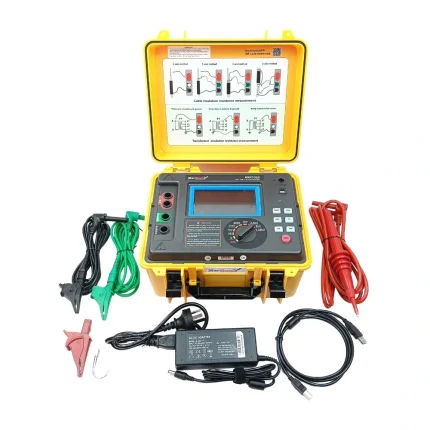
Marmonix insulation testers (megohmmeters) cover every common test voltage, from the 1000 V MIR-1000 insulation and continuity tester and the 2.5 kV 30-2 to the 5 kV MIR-510 and the 10 kV MIR-1020 with PI, DAR and ramp tests. Buying from Marmonix means you get the tester direct from the brand, with the official datasheet, warranty and technical support across the UAE and GCC.
Use them to check cables, motors, generators, transformers and switchgear at installation, before re-energising after a fault, and on planned maintenance, so failing insulation is found before it causes a trip, a fire or an electric shock.
Compare Marmonix insulation testers
ModelTest voltagesInsulation rangeOther functionsBest forMIR-1000100 / 250 / 500 / 1000 VUp to about 5.5 GΩContinuity to 999 Ω, AC/DC voltage 30–600 VElectricians: wiring, LV cables, small motors, panels30-2500 / 1000 / 2500 V0–20 GΩAC voltage to 600 V, data holdMaintenance: motors, cables and switchgear to 2.5 kVMIR-510250 V to 5 kV (5 steps)0.5 MΩ–10 TΩPI, DAR, ramp, filtered resistance; 1000-record memory; IP65 closedMV cables, motors, generators, commissioningMIR-1020250 V to 10 kV (6 steps)0.5 MΩ–20 TΩPI, DAR, ramp, filtered resistance; voltage, capacitance, leakage currentHV cables, transformers, large generators, utilities
How to choose an insulation tester
Test voltage: match it to the rated voltage of what you test. 500–1000 V for LV installations, 2.5 kV for higher-rated LV and some MV equipment, 5–10 kV for MV and HV assets.
Range: healthy MV and HV insulation can read in the TΩ range, so a 5 kV or 10 kV tester needs TΩ capability to show a real trend.
Diagnostics: choose PI, DAR and ramp tests (MIR-510, MIR-1020) for motors, generators and cables you trend over time.
Extras: continuity and voltage on one tool (MIR-1000) suit electricians; memory and USB upload (MIR-510, MIR-1020) suit reporting.
Safety: live-voltage warning or test blocking and automatic discharge protect the user and the tester.
Who uses insulation testers
Electrical contractors and MEP teams at testing and commissioning, facility and maintenance engineers, motor rewind shops, utilities and substations, oil and gas, and solar PV installers. For general electrical checks, see our digital multimeters and clamp meters, and read our buyer’s guide to the best insulation resistance testers in 2026.
Insulation tester FAQ
Which test voltage do I need?
Use 500 V for most low-voltage wiring and 1000 V for LV cables and motors up to about 1000 V; the MIR-1000 covers both. Use 2.5 kV for higher-rated motors and switchgear (the 30-2), and 5 kV or 10 kV for medium- and high-voltage cables, transformers and generators (the MIR-510 and MIR-1020). Always follow the equipment maker’s or the standard’s test voltage.
What are PI and DAR?
They are timed insulation tests. The polarisation index (PI) compares the reading at 10 minutes with the reading at 1 minute, and the dielectric absorption ratio (DAR) compares shorter times. A rising reading over time shows clean, dry insulation; a flat or falling one points to moisture or contamination. The MIR-510 and MIR-1020 run both automatically.
Is an insulation tester the same as a megger?
Yes. “Megger” is a brand name that is often used for any insulation resistance tester or megohmmeter. All Marmonix models apply a DC test voltage and display insulation resistance in MΩ, GΩ or TΩ.
How do I test insulation safely?
Isolate and lock off the circuit, prove it dead, disconnect electronics that the test voltage could damage, then run the test and let the tester discharge the circuit before touching it. Our step-by-step insulation resistance test guide explains each stage.
Do you supply insulation testers outside the UAE?
Yes. Marmonix supplies its insulation testers across the UAE, Saudi Arabia, Oman, Qatar, Kuwait and Bahrain, with official datasheets and local technical support.