

Best Digital Multimeters in 2026: How to Choose (Buyer’s Guide)
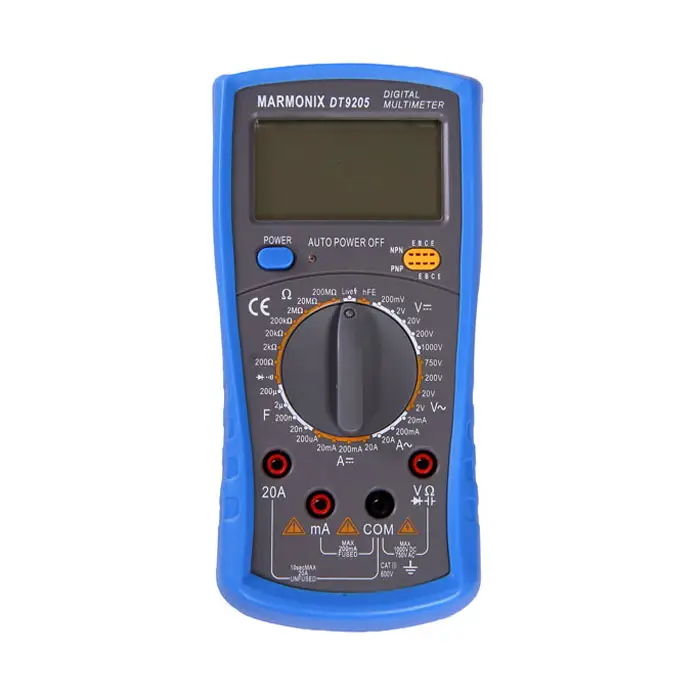
A digital multimeter (DMM) is the single most-used instrument on any electrical or electronics workbench — but choosing the wrong one quietly costs you accuracy, safety margin, and years of reliable service. This guide explains exactly what to compare in 2026, how each key specification translates into real-world performance, and which MarMonix models fit each type of work, so you can buy once and buy right.
Whether you are an electrician verifying a de-energised circuit, an HVAC technician chasing an intermittent fault, or an electronics engineer working at the bench, the best meter is the one matched to your voltage environment, accuracy requirement, and safety category. We break all three down, then map them to specific models.
What a Digital Multimeter Measures
At minimum, every quality DMM measures three core electrical quantities, and better units add several more that save you from carrying separate tools into the field.
Core measurements
Voltage (AC & DC) for checking supplies, batteries, and signal levels; current (amperage) for load and draw testing; and resistance (ohms) for verifying components and connections. Continuity with a fast audible beeper lets you confirm a connection without watching the display — essential when you are tracing wiring in a panel.
Advanced measurements
Mid- and high-tier meters add capacitance, frequency (Hz), diode test, temperature (via thermocouple), and duty cycle. A non-contact voltage (NCV) detector and a low-impedance (LoZ) mode that rejects induced phantom voltages are especially valuable for field electricians who need a fast, trustworthy live/dead check.
Key Specifications to Compare
True RMS vs. average-responding
A True RMS meter measures the real heating value of a waveform, even when that waveform is distorted by variable-speed drives, LED lighting, or switching power supplies. An average-responding meter assumes a clean sine wave and can read significantly low on modern non-linear loads. If you work on anything containing electronics, choose True RMS — the small price difference is repaid the first time it saves a misdiagnosis.
Counts, resolution, and accuracy
The count rating (for example 6,000 or 20,000 counts) sets how fine a reading the display can resolve before it must change range. Basic DC accuracy — quoted as a percentage of reading plus a number of least-significant digits — tells you how far to trust that number. For general electrical work ±0.5% is ample; for calibration and laboratory tasks, look for ±0.1% or better. Higher counts also reduce the number of range changes, which speeds up repetitive testing.
Input impedance and ghost voltages
Standard DMMs present a high input impedance (around 10 MΩ), which is ideal for electronics but can pick up ghost or phantom voltages on long unloaded cable runs. A LoZ mode briefly loads the circuit to dissipate that induced voltage, confirming whether a conductor is genuinely live.
Safety category (the spec people skip)
The CAT rating is not optional. Under IEC 61010, CAT II covers receptacle-level circuits, CAT III covers fixed installation and distribution boards, and CAT IV covers the service entrance and outdoor lines. Always pick a meter whose category and voltage rating exceed the environment you measure in — the category defines how much transient energy the meter can survive.
Build, range, and convenience
Auto-ranging speeds up everyday measurement, while manual range gives control on the bench. Look for a high-contrast backlit display, a rugged over-moulded case, input-jack warnings, and an auto-hold function for readings taken in awkward or poorly lit locations.
Bench versus field trade-offs
A field meter spends its budget on survivability — CAT rating, drop resistance, and sealing — whereas a bench meter spends it on resolution and accuracy. Knowing which side your work sits on prevents both over- and under-buying.
How to Choose by Use Case
Field electricians
Prioritise CAT III/IV rating, True RMS, LoZ mode, and NCV. Ruggedness, drop protection, and glove-friendly controls matter more than an exotic function list.
HVAC & appliance technicians
Temperature, capacitance (for motor-start and run capacitors), and a microamp range for flame-sensor testing are usually the deciding features.
Electronics & bench work
Favour high counts, fine resolution, capacitance, frequency, and tight accuracy over heavy field protection, since the bench environment is controlled.
MarMonix Digital Multimeters Compared
MarMonix builds a focused range so you can match the meter to the job without overpaying for features you will not use. Browse the full line-up in the MarMonix multimeters category, or compare the headline models below.
Model strengths
The MMU 112 is the all-round field meter with a rugged case and clear, high-contrast display. The MVC 97 adds extra functions for mixed electrical and electronics work, while the True-RMS DT-9205 is built specifically for distorted-waveform environments where average-responding meters fall short. For compact everyday use, the MMU-110 and the pocket-friendly MMU P1 keep the essentials within reach without bulk. Match the model to your CAT environment first, then to the feature set you will actually use.
Compact or full-size?
Choose a compact meter when portability and quick checks dominate your day; choose a full-size unit when you need a larger display, more functions, and easier two-handed operation inside a panel.
How to Use a Multimeter Safely
Inspect leads for cracks or exposed copper before every use, and start in the highest expected range when measuring manually. Never apply the current (A) jacks across a voltage source — that creates a near short-circuit through the meter. Keep your fingers behind the probe barriers, and de-energise circuits before measuring resistance or continuity. Treat every conductor as live until your own meter proves otherwise.
Frequently Asked Questions
Do I really need a True RMS multimeter?
If you measure anything fed by drives, dimmers, or switching power supplies, yes — an average-responding meter can under-read these loads by a wide margin and lead you to the wrong conclusion.
What CAT rating should I buy?
Choose one category above where you normally work. Most electricians are well served by a CAT III 600 V or CAT IV 600 V meter.
How often should a multimeter be calibrated?
Annually for professional use, or whenever the readings feed into safety, compliance, or billing decisions.
Can one multimeter cover every job?
A well-specified True RMS meter with the right CAT rating handles the vast majority of tasks, but bench specialists often keep a high-count meter as well.
Related Buyer’s Guides
Continue your research with our Clamp Meter vs Multimeter guide, the Earth Resistance Testers guide, or see every model in the multimeters category.