

The Best Multimeters for Beginners and Professionals
Choosing the best multimeter for beginners is not only about price. A good digital multimeter should be easy to use, accurate enough for everyday troubleshooting, safe for its intended application, and capable of measuring the values you actually need.
Top MarMonix Multimeter for Beginners
A digital multimeter is one of the most essential tools for electrical testing, electronics repair, home maintenance, automotive troubleshooting, and professional service work. Whether you are checking a battery, testing continuity, measuring AC voltage, or diagnosing an electrical fault, the right multimeter can make the job safer, faster, and more accurate.
However, the best multimeter for a beginner is not always the same as the best multimeter for a professional technician. Beginners usually need simple operation, automatic ranging, a readable display, and essential safety features. Professionals often need higher voltage ranges, current measurement, True RMS capability, temperature testing, and advanced functions such as inrush current detection.
In this guide, we provide a technical evaluation of three selected Marmonix multimeters, cross-referencing their performance capabilities with their official manufacturer specifications to ensure accuracy and help you make an informed, professional choice.
MarMonix MMU P1, MarMonix MMU 112, and DT-9205.
Explore Marmonix Multimeters
Compare digital multimeters for electrical testing, electronics repair, maintenance, and professional troubleshooting.
Quick recommendation: The MarMonix MMU P1 is the best multimeter for beginners, the MarMonix MMU 112 is the best option for professionals and advanced users, and the DT-9205 is a practical budget multimeter for general-purpose testing.
Best Multimeters at a Glance
Selecting the right tool depends on your specific technical needs and environment. To help you make an informed decision quickly, we have summarized the key specifications, measurement ranges, and primary advantages of our top-rated models in the comparison table below.
| Model | Best For | Voltage Range | Current Range | Main Advantage |
|---|---|---|---|---|
| MarMonix MMU P1 | Beginners | Up to 600 V AC/DC | _ | Simple operation, compact design, True RMS |
| MarMonix MMU 112 | Professionals | Up to 1000 V DC / 750 V AC | Up to 20 A AC/DC | True RMS, inrush current, temperature measurement |
| DT-9205 | Budget Users | Up to 1000 V DC / 750 V AC | Up to 20 A AC/DC | Wide functions at a budget-friendly level |
How We Selected These Multimeters
To choose the best multimeters for beginners and professionals, we focused on practical factors that matter in real testing applications:
- Ease of use for first-time users
- Voltage and current measurement capability
- True RMS availability
- Display resolution and readability
- Safety category information stated in the datasheet
- Extra functions such as capacitance, frequency, temperature, diode, and continuity testing
- Suitability for home, educational, electronics, and professional service applications
We avoided making unsupported claims where a datasheet does not clearly state a specification. This is especially important for safety ratings, True RMS performance, and high-current measurements.
1. MarMonix MMU P1: Best Multimeter for Beginners
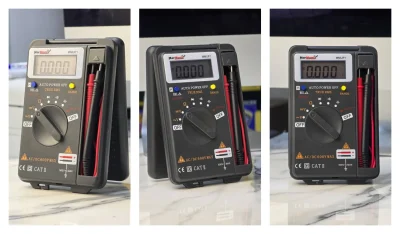
The MarMonix MMU P1 is the best choice for beginners because it combines simple operation, compact design, automatic ranging, and True RMS measurement. It is suitable for students, homeowners, hobbyists, and users who need a reliable multimeter for basic electrical and electronic troubleshooting.
One of the most important advantages of the MMU P1 is its user-friendly design. Beginners often struggle with selecting the correct measurement range. With automatic ranging, the meter can simplify this process and make everyday measurements easier and less confusing.
MMU P1 Key Specifications
The MarMonix MMU P1 is engineered to provide a perfect balance of precision and portability. Below is a detailed breakdown of its core technical specifications, highlighting the measurement ranges and advanced features that make it an essential tool for both diagnostic and routine electrical tasks.
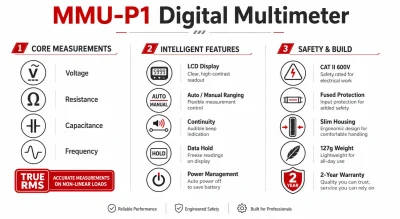
- DC voltage measurement up to 600 V
- AC voltage measurement up to 600 V
- Resistance measurement up to 40 MΩ
- Capacitance measurement up to 9.999 mF
- Frequency measurement up to 9.999 MHz
- True RMS measurement
- 4000-count LCD display
- Automatic and manual ranging
- Diode and continuity testing
- Duty cycle measurement
- Data Hold and relative measurement
- Automatic power-off
- Low-battery warning
- Overload warning
- CAT II 600 V safety rating
- Fused input protection
- Slim ABS housing
- Approximate dimensions: 125 × 80 × 19.5 mm
- Approximate weight: 127 g
- Two-year warranty

Why the MMU P1 Is Good for Beginners
The MMU P1 offers the functions most beginners need without overwhelming them with unnecessary complexity. It can measure voltage, resistance, capacitance, frequency, duty cycle, diode status, and continuity. These functions are enough for many common tasks, including checking batteries, testing simple circuits, troubleshooting adapters, and learning basic electronics.
True RMS measurement is another valuable feature. Many entry-level multimeters do not clearly offer True RMS, but this feature can improve AC measurement reliability when the waveform is not a perfect sine wave. This makes the MMU P1 a stronger beginner option than many basic meters.
Limitations of the MMU P1
The MMU P1 is best used as a general-purpose and educational multimeter. Its stated safety rating is CAT II 600 V, so users should not treat it as a heavy-duty industrial meter. Also, the current measurement range is not clearly specified in the reviewed datasheet, so it should not be promoted as a high-current testing instrument.
2. MarMonix MMU 112: Best Multimeter for Professionals
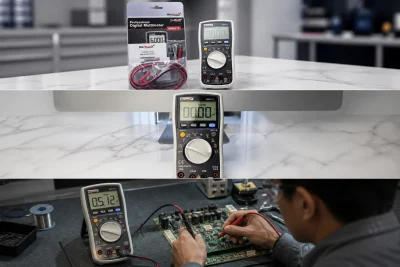
The MarMonix MMU 112 is the best choice for professionals and advanced users in this comparison. It offers a broader measurement range, True RMS capability, current measurement up to 20 A, temperature testing, and inrush current detection.
These features make the MMU 112 suitable for technicians, electricians, maintenance teams, repair specialists, and users who need more advanced diagnostic functions than a basic beginner multimeter can provide.
MMU 112 Key Specifications
Designed for professionals who demand higher accuracy and robust performance, the MarMonix MMU 112 offers expanded measurement capabilities and enhanced safety features. The following specifications detail its superior range, precision levels, and the advanced diagnostic functions that set it apart in demanding electrical environments.
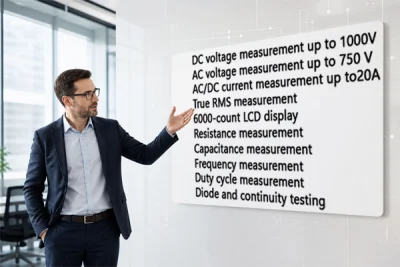
- DC voltage measurement up to 1000 V
- AC voltage measurement up to 750 V
- AC/DC current measurement up to 20 A
- True RMS measurement
- 6000-count LCD display
- Backlit display
- DC voltage accuracy: ±(0.5% + 3 digits)
- AC voltage accuracy: ±(1.0% + 3 digits)
- Resistance measurement
- Capacitance measurement
- Frequency measurement
- Duty cycle measurement
- Diode and continuity testing
- Temperature measurement from -20°C to 1000°C with thermocouple
- Inrush current detection
- Data Hold
- Automatic power-off
- Built-in light for low-light conditions
- ABS housing
- Includes two test-lead sets, thermocouple, and two AA batteries
- Two-year warranty
Why Professionals May Prefer the MMU 112
Professional troubleshooting often requires more than basic voltage and resistance measurement. For example, motor circuits and inductive loads may require inrush current checking. HVAC, maintenance, and equipment service tasks may also benefit from temperature measurement.
The MMU 112 also provides a 6000-count display, which offers finer resolution than a 4000-count meter. The backlit display and built-in light can help users work in panels, cabinets, service rooms, and low-light environments.
Limitations of the MMU 112
The MMU 112 offers more features than most beginners need. If you only want to test batteries, check continuity, or measure basic voltage, the MMU P1 may be easier and more suitable.
3. DT-9205: Best Budget Multimeter
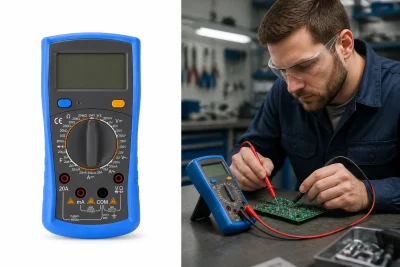
The DT-9205 is a strong option for users who want a budget-friendly multimeter with many measurement functions. It is suitable for home use, basic electronics, hobby projects, laboratory tasks, factory use, and general troubleshooting.
Compared with the MMU P1, the DT-9205 offers broader current measurement information in the reviewed datasheet, including AC and DC current measurement up to 20 A. It also includes transistor hFE testing, temperature measurement, frequency measurement, and phase-wire detection.
DT-9205 Key Specifications
For those seeking a versatile and budget-friendly solution without compromising on essential features, the DT-9205 is an ideal choice. It covers a wide range of measurement needs, from standard voltage to specialized transistor testing. Explore its full technical capabilities and impressive measurement ranges in the comprehensive list below.
- DC voltage ranges from 200 mV to 1000 V
- AC voltage ranges from 2 V to 750 V
- DC current ranges from 200 µA to 20 A
- AC current ranges from 20 mA to 20 A
- Resistance ranges from 200 Ω to 200 MΩ
- Capacitance ranges from 20 nF to 200 µF
- Diode testing
- Continuity testing
- Transistor hFE testing
- Temperature measurement
- Frequency measurement
- Phase-wire detection function
- Automatic power-off
- Overload protection described in the datasheet

Why Budget Users May Prefer the DT-9205
The DT-9205 offers a wide set of functions for its category. It can be a useful choice for users who need a flexible multimeter for general testing but do not necessarily require a premium professional model.
It is especially attractive for electronics learners and hobbyists who may need resistance, capacitance, diode, continuity, transistor, temperature, and frequency functions in one device.
Limitations of the DT-9205
The reviewed DT-9205 datasheet does not state True RMS capability. For users who frequently measure non-sinusoidal AC waveforms, a True RMS meter such as the MMU P1 or MMU 112 may be a better choice.
The datasheet also does not clearly specify a CAT safety rating. Although it mentions safety design and overload protection, users should not assume a specific CAT category unless it is confirmed by official product markings or documentation.
Which Multimeter Should You Choose?
Selecting the right tool depends entirely on your specific applications and expertise level. Whether you are a student just starting out or a professional technician working in demanding industrial environments, we have categorized our top models to help you make an informed decision. Use the guide below to find the perfect match for your toolkit based on your daily measurement requirements.
Choose the MMU P1 if:
You are a beginner, student, homeowner, or hobbyist who wants simple operation, automatic ranging, True RMS, and essential measurement functions.
Choose the MMU 112 if:
You are a technician, electrician, or advanced user who needs 20 A current measurement, 1000 V DC measurement, True RMS, temperature testing, and inrush current detection.
Choose the DT-9205 if:
You want a budget-friendly multimeter with many functions for home use, electronics learning, hobby projects, and general troubleshooting.
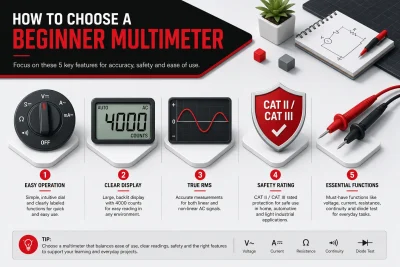
What to Look for in the Best Multimeter for Beginners
Choosing the right digital multimeter involves more than comparing measurement ranges. Factors such as accuracy, safety features, ease of use, durability, and the intended application all play an important role in making the right decision. In the following sections, we will review the key differences between these models and explain which option is best suited to different users and electrical testing requirements.
1. Easy Operation
A beginner-friendly multimeter should be easy to read and simple to operate. Automatic ranging is especially useful because it reduces the need to manually select the correct measurement range.
2. Clear Display
A clear LCD display helps users read values quickly and reduces mistakes. A 4000-count display is suitable for many beginner tasks, while a 6000-count display offers finer resolution for more advanced work.
3. True RMS Measurement
True RMS is important when measuring AC signals that are not perfect sine waves. Many modern electronic devices, power supplies, and variable-speed equipment can produce non-linear waveforms. A True RMS multimeter can provide more reliable AC readings in these situations.
4. Safety Rating
Safety category ratings such as CAT II, CAT III, and CAT IV indicate the type of electrical environment a meter is designed for. Beginners should always choose a meter that matches the measurement environment and should never exceed the meter’s rated limits.
5. Essential Test Functions
A good beginner multimeter should include voltage, resistance, continuity, and diode testing. Additional functions such as capacitance, frequency, duty cycle, and temperature measurement can be useful depending on the application.
Safety Tips for Using a Digital Multimeter
- Always inspect test leads before measurement.
- Do not use damaged probes or cracked meter housings.
- Select the correct measurement mode before connecting the probes.
- Never measure voltage while the meter is set to current mode.
- Use the correct input terminal for current measurements.
- Do not exceed the meter’s voltage, current, or CAT safety rating.
- Use extra caution when working with mains voltage or high-energy circuits.
- If you are not trained for high-voltage work, seek help from a qualified professional.
Final Verdict: The Best Multimeter Depends on Your Application
If you are looking for the best multimeter for beginners, the MarMonix MMU P1 is the strongest choice in this comparison. It is compact, easy to use, supports automatic ranging, and includes True RMS measurement.
If you are a professional or advanced user, the MarMonix MMU 112 is the better option thanks to its wider measurement range, 20 A current capability, 6000-count display, temperature measurement, and inrush current detection.
If you need a budget-friendly multimeter with many practical functions, the DT-9205 is a flexible choice for general testing, electronics, and hobby applications.
Frequently Asked Questions
What is the best multimeter for beginners?
The MarMonix MMU P1 is the best multimeter for beginners in this comparison because it offers automatic ranging, True RMS measurement, a compact design, a 4000-count display, and essential test functions for everyday electrical and electronics work.
Do beginners need a True RMS multimeter?
True RMS is not required for every basic task, but it is a valuable feature. It can provide more reliable AC measurements when testing non-sinusoidal waveforms from modern electronic equipment, power supplies, and variable-speed devices.
Which multimeter is best for professionals?
The MarMonix MMU 112 is the best professional option in this comparison. It supports True RMS measurement, AC/DC current up to 20 A, voltage measurement up to 1000 V DC, temperature measurement, and inrush current detection.
Is the DT-9205 a good budget multimeter?
Yes. The DT-9205 is a good budget multimeter for users who need many functions, including voltage, current, resistance, capacitance, frequency, temperature, diode, continuity, and transistor hFE testing. However, the reviewed datasheet does not state True RMS capability or a specific CAT safety rating.
What safety rating should I look for in a multimeter?
The correct safety rating depends on where the multimeter will be used. Always match the meter’s CAT rating and voltage rating to the electrical environment. Do not assume a safety category unless it is clearly stated on the product or in official documentation.