

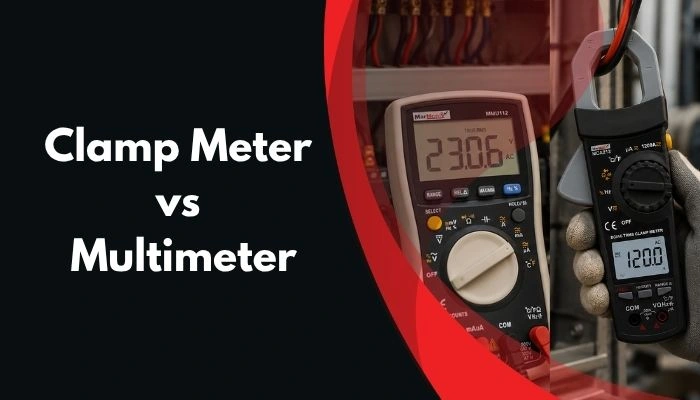
Clamp Meter vs Multimeter
⚡Quick Answer
A clamp meter measures current around a conductor without opening the circuit, so it is faster and safer for live load checks, motor current, feeder testing, and troubleshooting energized panels. A multimeter measures voltage, resistance, continuity, and other electrical values with higher precision, and current is usually measured through test leads in series. In practice, electricians and maintenance teams often need both tools, but the right choice depends on whether your main job is current measurement or general electrical testing.
If you are deciding between clamp meter vs multimeter, start with the task, not the tool. For live current checks, a clamp meter is usually the faster and safer option. For voltage, resistance, continuity, capacitance, diode testing, and detailed fault-finding, a multimeter is the more precise and versatile instrument. That is why many professionals keep both in the toolbox.
The real question is not which tool is better. It is which tool fits the job. If you regularly troubleshoot live panels, motors, feeders, or load balance issues, the clamp meter saves time and reduces risk. If your work involves electronics, control circuits, bench testing, or precise signal checks, the multimeter remains the primary instrument.
Clamp Meter vs Multimeter: What’s the Difference?
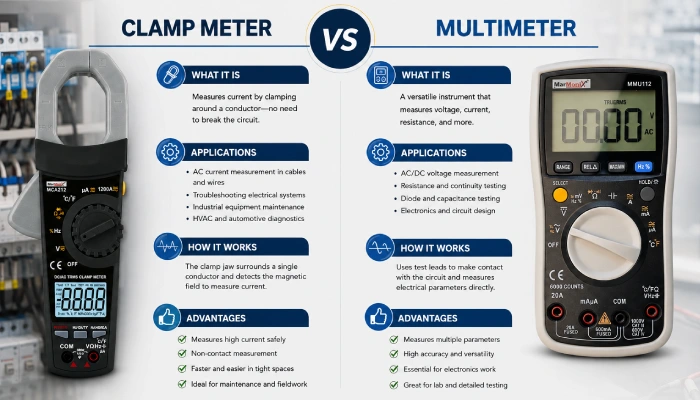
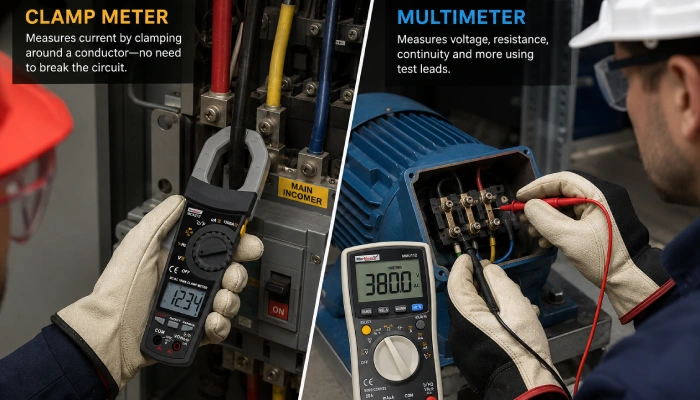
The difference is simple but important. A clamp meter measures current by sensing the magnetic field around a conductor. You open the jaw, place it around one wire, and read the current without disconnecting the circuit. A multimeter measures electrical values through test probes — to measure current it usually must be inserted in series with the load, which means the circuit must be opened.
That single difference changes everything in the field. Clamp meters are built for quick current checks on energized systems; multimeters are built for broader electrical diagnosis where accuracy and range selection matter more.
What are clamp meters and multimeters?
A clamp meter is a current-measuring tool designed for speed and safety in field work — especially when the circuit is live, the conductor is large, or opening the circuit would interrupt service. A multimeter is a broader test instrument that measures voltage, resistance, continuity, capacitance, frequency, and sometimes current and temperature.
How Does a Clamp Meter Measure Current Without Touching the Wire?
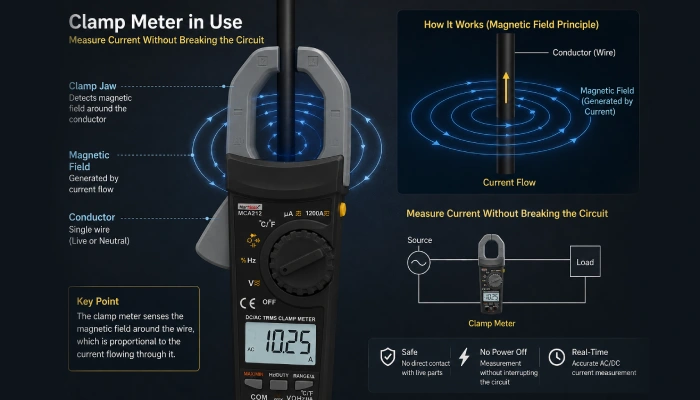
A clamp meter measures the magnetic field produced by current flowing through a conductor. Since current creates a magnetic field, the meter can infer the current value without direct electrical contact — which is why you can measure load current without breaking the circuit.
Current Transformer (CT) Clamp
Typically reads AC current only — the most common and affordable type for mains and motor work.
Hall-Effect Clamp
Reads both AC and DC — essential for solar, battery, automotive, and DC-drive work.
When a Clamp Meter Wins
- Motor current checks
- Feeder and branch load checks
- Phase balancing
- Live panel troubleshooting
- Fast inspections where disconnecting the circuit is not practical
If the main job is current measurement, the clamp meter is usually the better tool. It reduces setup time and avoids opening the circuit — which is why the intent behind digital clamp meter vs multimeter often comes from electricians and maintenance users who need speed more than lab-style precision.
When a Multimeter Wins
- Voltage measurement
- Resistance and continuity checks
- Capacitance testing
- Low-current troubleshooting
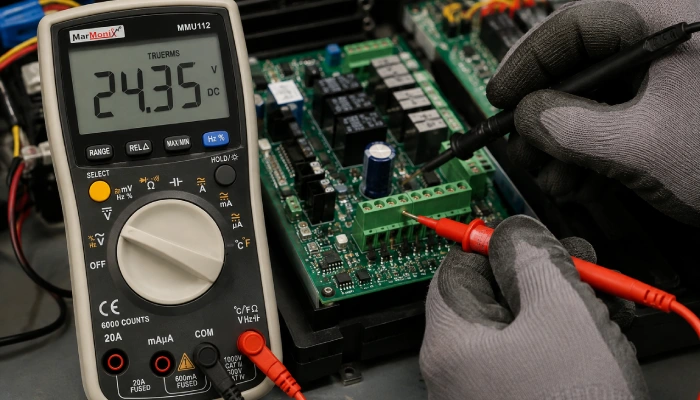
- Electronics and control-board diagnostics
If your daily work is centered on verifying signals, diagnosing faults, or checking components, a multimeter is usually more precise and useful. That is why the answer to Why buy a Multimeter over a Clamp? is simple: many tasks do not require clamp-style current measurement at all.
Key Specifications to Compare
Before buying either tool, compare the features that actually affect field performance. A cheap meter may look fine on paper but become frustrating in real use.
💰
Clamp Meter vs Multimeter Cost
Clamp Meter vs Multimeter Cost
Cost should not be judged only by purchase price. A clamp meter may cost more than a basic multimeter, but it can save time on live current checks and reduce operational risk. For electronics users, a precise multimeter often gives better value because it matches the job more closely. For industrial teams, the real calculation is total value: speed, safety, accuracy, and the number of tasks one instrument can handle.
speed, safety, accuracy, and the number of tasks one instrument can handle.
Choose a Clamp Meter If You…
- Need to measure current without interrupting the circuit
- Work on motors, feeders, panels, or distribution systems
- Need faster daily inspections
- Want safer live load checking
- Need a meter strong in field troubleshooting
Choose a Multimeter If You…
- Need voltage, resistance, continuity, or capacitance more often than current
- Work on electronics, control boards, or bench diagnostics
- Want finer measurement detail
- Prefer a compact general-purpose tester
- Need a multi-function tool for everyday electrical troubleshooting
Choose a Clamp Meter with Built-In Multimeter Functions If You…
Choose a clamp meter with built-in multimeter functions if you want one tool for most field jobs. This is the best option for maintenance teams, electricians, and service technicians who need current measurement plus voltage, continuity, resistance, and often temperature or NCV in one instrument.
Verified Multimeter Models From MarMonix
The verified product files show four MarMonix multimeters that can support different use cases. They are not clamp meters, but they are useful reference points when a multimeter is the better choice.
🛡️
Safety and Measurement Mistakes to Avoid
Safety and Measurement Mistakes to Avoid
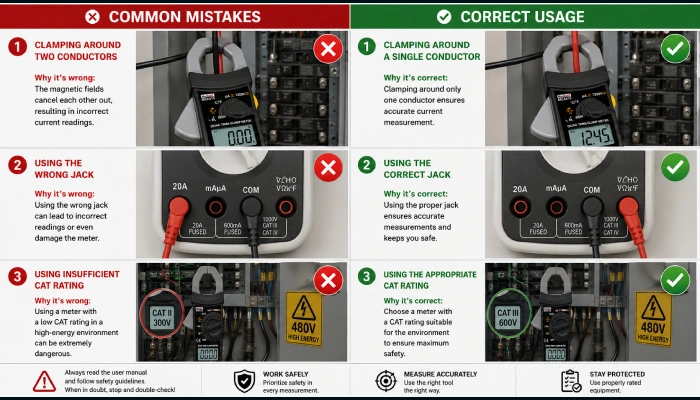
The biggest clamp meter mistake is clamping around more than one conductor, which can cancel the reading. The biggest multimeter mistake is trying to measure current the wrong way or selecting the wrong input jack. Always verify the meter category, range, and connection method before testing.
- Do not exceed the meter’s voltage or current rating
- Use the correct input terminals for current measurement
- Keep one conductor only inside a clamp jaw
- Prefer True RMS on modern electrical loads
- Match the CAT rating to the installation environment
FAQ
❓ What are clamp meters and multimeters?
Clamp meters measure current around a conductor without opening the circuit. Multimeters measure voltage, resistance, continuity, and other values through probes; some also measure current through test leads.
❓ Why buy a multimeter over a clamp?
Buy a multimeter when your work depends more on voltage, resistance, continuity, capacitance, and precise troubleshooting than on fast current measurement.
❓ How does a clamp meter measure current without touching the wire?
It detects the magnetic field created by current flowing through the conductor and converts that field into a current reading.
❓ Clamp meter vs multimeter cost: which is cheaper?
Basic multimeters are often cheaper, but clamp meters can offer better field efficiency and safer live current measurement. The better value depends on the work you actually do.
❓ Choose a clamp meter if you…
Choose a clamp meter if you regularly check live current, troubleshoot motors, or work on panels where breaking the circuit is not practical.
❓ Choose a multimeter if you…
Choose a multimeter if you need more frequent voltage, resistance, continuity, capacitance, or electronics testing.
💡
Expert Tip
Expert Tip
For most industrial users, the best answer to clamp meter vs multimeter is not one or the other. Use a clamp meter for live current and a multimeter for detailed electrical diagnosis. If you want one instrument that covers both jobs, choose a clamp meter with built-in multimeter functions.