
Best Radar & Ultrasonic Level Transmitters in 2026
A level transmitter continuously measures how full a tank, silo, or channel is and sends that reading to your control system — the foundation of inventory management, batch control, and overflow protection. Choosing between radar and ultrasonic technology, and specifying it correctly, determines whether your measurement stays reliable through foam, vapour, dust, and temperature swings. This 2026 guide explains how each works, the specifications that matter, and which MarMonix transmitters suit which process.
The right transmitter depends on your medium, process conditions, and required range and accuracy. Get the technology choice right and the rest is configuration; get it wrong and no amount of tuning will fix it.
What a Level Transmitter Does
Unlike a simple point switch that only signals “full” or “empty”, a transmitter provides a continuous measurement — usually as a 4–20 mA signal or a digital output — representing the level across the whole vessel.
Continuous versus point measurement
Continuous level enables inventory, trending, and proportional control, while point switches only protect against extremes. For process control and stock management, continuous measurement is essential.
Where level transmitters are used
Water and wastewater, chemical and fuel storage, food and beverage, and bulk-solids silos all depend on reliable continuous level for safety and efficiency.
Radar vs. Ultrasonic
Ultrasonic
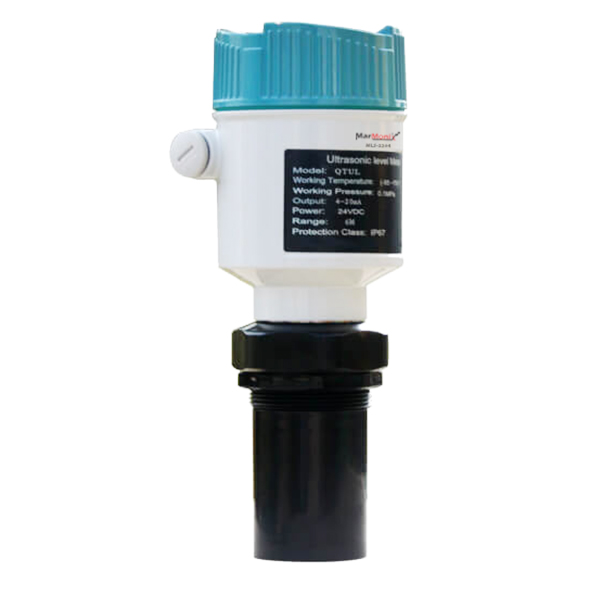
Ultrasonic transmitters send a sound pulse and time its echo. They are economical and non-contact, and work well on liquids in stable conditions, but their accuracy can suffer from vapour, foam, dust, and temperature gradients, because these affect the speed of sound.
Radar
Radar is the robust choice for demanding processes. Because microwaves are largely unaffected by vapour, temperature, and pressure, a radar transmitter holds its accuracy where ultrasonic struggles — the preferred technology for volatile, hot, or dusty applications.
Guided-wave versus free-space
A free-space (non-contact) radar looks down at the surface, while guided-wave radar runs the signal along a probe for difficult media and low-dielectric liquids.
Key Specifications to Compare
Measuring range and accuracy
The transmitter must span your full vessel height with accuracy appropriate to the duty — tighter for custody and batch work, looser for simple inventory.
Medium and dielectric
For radar, the liquid’s dielectric constant affects how strong an echo it returns; low-dielectric media may need guided-wave radar. For ultrasonic, confirm the medium is not heavily foaming or vapour-laden.
Process connection and environment
Match the process connection, material, and housing rating to your pressure, temperature, and hazardous-area requirements.
How to Choose by Use Case
Water and wastewater
Non-contact radar or ultrasonic suits open channels and sumps; choose radar where vapour or foam is present.
Chemical and fuel storage
Radar handles vapour, changing density, and aggressive media more reliably than ultrasonic.
Bulk solids and silos
Radar copes far better with dust and steep material angles than sound-based methods.
MarMonix Level Transmitters Compared
MarMonix offers radar and ultrasonic transmitters for process level; see the range in the level transmitters category, or compare the key models below.
Model strengths
The MRL-3100, MRL-3300, and MRL-3500 are radar transmitters spanning a range of process duties, while the MLS-2204 ultrasonic sensor is an economical non-contact option for stable liquid applications. Match the technology to your medium and conditions first, then the range and process connection.
How to Specify and Install Reliably
Mount the transmitter away from inlet streams, ladders, and agitators that create false echoes, keep the beam clear of the vessel wall, and set the empty and full reference points carefully during commissioning. Account for the medium’s properties — dielectric for radar, vapour and foam for ultrasonic — before finalising the choice. A few minutes spent on mounting position prevents most level-measurement headaches.
Outputs, Communication, and Integration
A level transmitter only adds value when its reading reaches your control system cleanly, so the output and communication options deserve as much thought as the sensing technology.
Analogue and digital outputs
The 4–20 mA current loop remains the workhorse output because it is robust over long cable runs and immune to voltage drop. Many transmitters add a HART digital layer on the same wires for remote configuration and diagnostics, while fieldbus options suit fully digital plants. Confirm the output matches what your PLC or DCS expects before purchase.
Alarms and control
Continuous level lets you set high and low alarm thresholds and drive pumps or valves proportionally rather than simply on and off. This protects against both overflow and dry-running, and smooths process control compared with crude point-switch logic.
Diagnostics and reliability
Modern transmitters report echo quality and fault status, so you learn that a measurement is degrading before it fails outright — turning an unplanned trip into a scheduled maintenance task.
Common Mistakes to Avoid
Choosing ultrasonic for a foaming or vapour-rich tank, mounting in the fill stream, ignoring dielectric for radar, and skipping a proper empty/full calibration are the usual errors. Technology selection and mounting position matter more than headline accuracy; both must suit the real process.
Frequently Asked Questions
Radar or ultrasonic — which should I choose?
Radar is more robust against vapour, foam, dust, and temperature, making it the safer choice for demanding media. Ultrasonic is economical for stable liquid applications.
What does the dielectric constant affect?
For radar, a higher dielectric liquid returns a stronger echo. Low-dielectric media may require guided-wave radar for a reliable signal.
Why is my level reading jumping?
False echoes from agitators, ladders, the fill stream, or the vessel wall are common causes. Repositioning the transmitter and mapping out false echoes usually resolves it.
Can these measure solids as well as liquids?
Radar generally handles bulk solids and dust far better than ultrasonic. Confirm the specific transmitter is rated for your material and silo geometry.
Why is the 4-20 mA loop still so common?
It is simple, robust over long cable runs, and largely immune to voltage drop and electrical noise. A live-zero at 4 mA also lets the system distinguish a genuine empty reading from a broken wire, which adds a layer of built-in fault detection.
Related Buyer’s Guides
Explore our Laser Distance Meters guide, the Power Quality Analyzers guide, or browse every model in the level transmitters category.