
Best Laser Distance Meters in 2026: Buyer’s Guide
A laser distance meter replaces the tape measure with a button: point, click, and read a precise distance in an instant — alone, on any surface, and over distances no tape can reach. For builders, estimators, real-estate professionals, and facilities teams, it means faster, more accurate measurement with fewer mistakes. This 2026 guide explains how laser meters work, the specifications that matter, and which MarMonix models fit each kind of work.
The right meter for you depends on your maximum range, required accuracy, and the calculation modes your work needs. We unpack each and connect them to real tasks below.
What a Laser Distance Meter Does
The device emits a laser pulse, measures the time or phase shift of the reflected light, and converts it to a distance — typically accurate to a couple of millimetres. One person can measure a room, a facade, or a ceiling height in seconds without a helper or a ladder.
Why it beats a tape
A laser meter is faster, works solo, reaches further, and avoids the sag and misreading errors of a long tape. It also stores results and performs calculations a tape never could.
Where laser meters are used
Construction take-offs, interior fit-out, real-estate floor areas, surveying checks, and facilities planning all rely on quick, repeatable distance and area measurement.
Key Specifications to Compare
Range
Indoor work may need only 40–60 m, while exterior and surveying tasks call for 100 m or more. Choose a range that covers your longest shot with headroom, since maximum range falls in bright light or on poor surfaces.
Accuracy
Accuracy is the spec that defines trust. Quality meters quote a figure such as ±1.5 mm under good conditions. For estimating and construction this is ample; for precise setting-out, confirm the figure holds at your working distance and over your target surface.
Measurement modes
Beyond simple distance, look for area and volume, continuous (min/max) for finding the true shortest or longest dimension, and indirect (Pythagoras) modes that calculate a height or width you cannot reach directly.
Display, memory, and connectivity
A backlit display, on-board memory, and Bluetooth export to a phone or CAD app speed up documentation and reduce transcription errors.
Long-Range and Outdoor Use
Sunlight washes out the laser dot and reduces range, so for exterior work consider a meter with a digital viewfinder/camera to aim at a distant target, plus a tripod thread for stability. A bright target plate also helps the beam return reliably from far or dark surfaces.
How to Choose by Use Case
Interior fit-out and estimating
A 40–60 m meter with area, volume, and memory covers most indoor measurement and quoting.
Construction and exterior
Choose longer range, a viewfinder for aiming, and a tripod mount for stable long shots.
Real estate and facilities
Fast area calculation and Bluetooth export to floor-plan apps streamline documentation.
MarMonix Laser Distance Meters Compared
MarMonix offers laser distance meters for construction and interior work; see the range in the laser distance meters category, or compare the key models below.
Model strengths
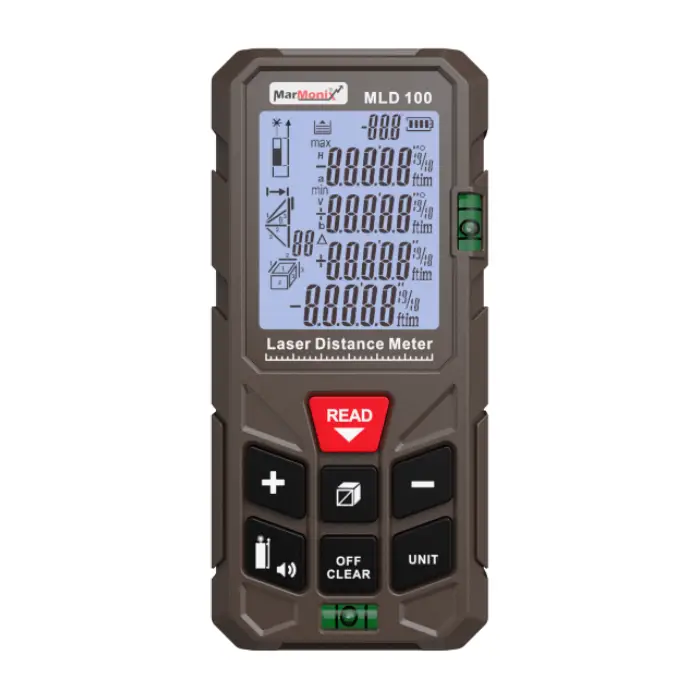
The MLD 100 reaches up to 100 m for larger spaces and exterior work, while the MLD 60 is the compact choice for everyday interior measurement. Match the range to your longest measurement, then choose the calculation modes you will actually use.
How to Measure Accurately
Brace the meter against a firm edge or use a tripod, aim at a matte, light-coloured target where possible, and measure from a consistent reference (front or rear of the device). Take a few readings and confirm they agree, and use continuous mode to find a true perpendicular shortest distance. A steady hand and a good target surface matter as much as the meter’s rated accuracy.
Calculation Modes in Practice
The calculation modes are what turn a laser meter from a faster tape into a genuine productivity tool, so it is worth knowing how each is used on site.
Area and volume
Area measures a room or wall in two clicks and is ideal for flooring, paint, and tiling take-offs, while volume adds a third dimension for concrete, excavation, and HVAC sizing. The meter does the arithmetic, removing a common source of estimating error.
Continuous and stake-out
Continuous (min/max) mode lets you sweep the beam to find the true shortest distance to a wall or the exact diagonal of a room, while stake-out marks repeated equal intervals — invaluable for setting out studs, joists, or fixings at a fixed spacing.
Indirect height with Pythagoras
When a target is out of reach, Pythagoras mode combines two or three measurements to calculate a height or width you could never tape directly — such as the top of a facade or a high ceiling. One person on the ground can measure what used to need a ladder and a colleague.
Common Mistakes to Avoid
Measuring from the wrong reference end, aiming at a dark or glossy surface, hand-shake over long shots, and exceeding the meter’s range in bright light are the frequent errors. Confirm the reference point and target quality first, and use a tripod for anything long or critical.
Frequently Asked Questions
How accurate are laser distance meters?
Good meters achieve around ±1.5 to 2 mm under favourable conditions. Accuracy can fall on dark, glossy, or very distant targets, so test in your real conditions.
Can I use one outdoors in sunlight?
Yes, but range drops and the dot becomes hard to see. A digital viewfinder, target plate, and tripod greatly improve long-range outdoor use.
What is Pythagoras mode for?
It calculates a height or width you cannot measure directly by combining two or three accessible measurements — ideal for facades and ceilings.
Do I need Bluetooth?
If you transfer measurements into floor plans or estimating software, Bluetooth export saves time and eliminates transcription errors.
From which end does it measure?
Most meters let you set the reference to the front edge, the rear, or a tripod thread. Choosing the correct reference for each measurement prevents a consistent offset error across your whole survey.
Related Buyer’s Guides
Explore our Level Transmitters guide, the Moisture Meters guide, or browse every model in the laser distance meters category.