
Best Sound Level Meters in 2026: How to Choose
A sound level meter measures noise objectively, in decibels, so you can protect hearing, satisfy regulations, and resolve complaints with data instead of opinion. Whether you are running a workplace noise assessment, checking an HVAC installation, or investigating an environmental nuisance, the right meter depends on the accuracy class, weighting, and logging your task demands. This 2026 guide explains how sound level meters work and where the MarMonix model fits.
Noise is deceptively easy to underestimate by ear, and the decibel scale is logarithmic, so small numbers hide large differences. A reliable meter, used correctly, is the only way to know where you really stand.
What a Sound Level Meter Measures
The instrument converts sound pressure into a sound pressure level (SPL) in decibels (dB), referenced to the threshold of human hearing. Because the scale is logarithmic, a 3 dB increase represents roughly a doubling of sound energy — which is why even modest readings deserve attention.
Frequency weighting
A-weighting (dBA) mimics the sensitivity of human hearing and is used for almost all occupational and environmental work, while C-weighting (dBC) is used for peak and low-frequency assessment. Match the weighting to the standard you are working to.
Time weighting
Fast and Slow time weighting change how quickly the reading responds, and an Leq (equivalent continuous level) function averages fluctuating noise over a period — the basis of most exposure assessments.
Key Specifications to Compare
Accuracy class
Class defines whether your readings are legally usable. Under IEC 61672, Class 1 instruments are for precision and regulatory measurement, while Class 2 suits general surveys and indicative checks. Always confirm which class your local regulations require before you buy.
Measurement and frequency range
The meter should span from quiet ambient levels (around 30 dB) to loud industrial noise (130 dB or more), across the audible frequency range, so it captures both faint and intense sources.
Microphone quality
The microphone is the heart of the instrument; a stable, well-specified capsule is what makes readings repeatable and trustworthy.
Logging, peak hold, and outputs
For assessments, look for data logging, max/min and peak hold, and the ability to export results for a report. A logged record is far more persuasive than a single noted figure.
Calibration and Standards
A sound level meter should be field-checked with an acoustic calibrator before and after important measurements, and periodically laboratory-calibrated to stay traceable. Occupational assessments typically reference limits such as those in workplace noise regulations, where action values trigger hearing-protection and control measures. Calibrating immediately before a measurement is the simplest way to keep your data defensible.
How to Choose by Use Case
Workplace noise assessment
Prioritise the correct accuracy class, A-weighting, Leq, and logging to document exposure over a shift.
Environmental and community noise
Look for low noise floor, logging, and weather-resistant accessories for outdoor surveys.
HVAC, education, and spot checks
A capable Class 2 meter with hold and clear display covers commissioning and quick indicative readings.
The MarMonix Sound Level Meter
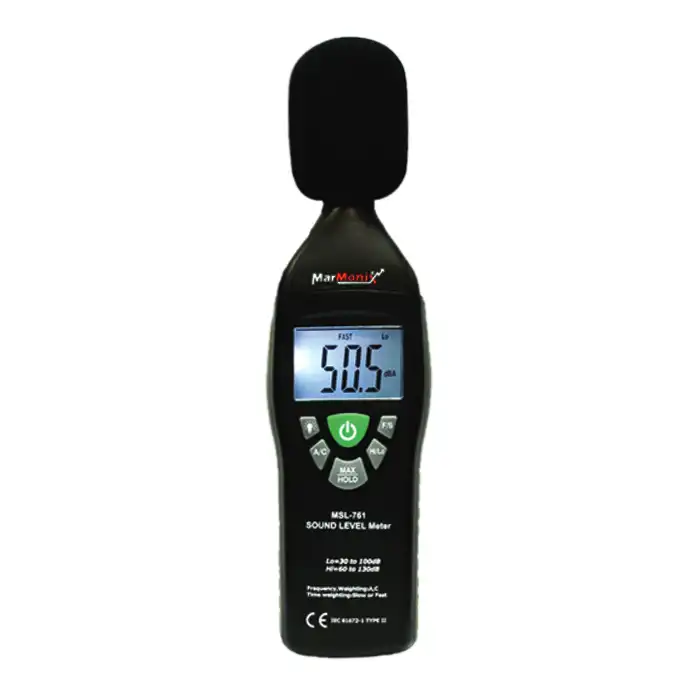
For portable, everyday noise measurement, the MarMonix MSL-761 Mini Sound Level Meter offers A-weighted measurement in a compact, easy-to-carry form for spot checks, commissioning, and indicative surveys. Browse related instruments in the sound level meters category. Confirm the accuracy class against your regulatory requirement before relying on readings for compliance.
Where it shines
The compact MSL-761 is ideal when you need a fast, repeatable indication of noise level — for example confirming that a fan, pump, or workspace sits within an expected range before commissioning a full Class 1 assessment.
How to Take Accurate Readings
Field-calibrate first, hold the microphone at the position of concern (often head height for occupational work), and keep your body from shielding the mic. Use a windshield outdoors, measure for long enough to capture the Leq of fluctuating noise, and note the sources present. A reading without context — source, distance, and duration — is hard to act on later.
Understanding Noise Exposure
Hearing damage depends not just on how loud a sound is, but on how long someone is exposed to it — a relationship every assessment must capture.
Level and time together
Because the decibel scale is logarithmic, a small rise in level sharply shortens the safe exposure time. This trade-off between loudness and duration is why occupational standards specify a daily exposure level rather than a single peak figure. A moderate noise endured all day can be as damaging as a brief loud burst.
From Leq to daily dose
The Leq averages fluctuating noise into one equivalent steady level, which is then combined with exposure time to estimate the daily noise dose. This is the number that determines whether hearing protection and engineering controls are legally required, so capturing a representative Leq over a full task is the heart of a credible assessment.
Common Mistakes to Avoid
Skipping field calibration, using the wrong weighting, measuring too briefly, and ignoring wind or reflections are the usual errors. Reflective surfaces and your own body can both distort a reading, so position the meter thoughtfully and document the setup.
Frequently Asked Questions
What is the difference between Class 1 and Class 2?
Class 1 meters are more precise and are usually required for regulatory and legal measurements; Class 2 meters suit general surveys and indicative checks.
Why use A-weighting?
A-weighting matches how human hearing responds across frequencies, so dBA correlates with perceived loudness and hearing-damage risk — the basis of occupational limits.
How often should I calibrate?
Field-check with an acoustic calibrator before and after important measurements, and send the meter for traceable laboratory calibration periodically.
Can a phone app replace a sound level meter?
Apps are useful for rough awareness but lack a calibrated microphone and defined accuracy class, so they are not suitable for compliance.
What does a 3 dB increase really mean?
On the logarithmic decibel scale, +3 dB represents approximately double the sound energy, even though it may sound only slightly louder. This is why noise control targets are often expressed in just a few decibels.
Related Buyer’s Guides
Explore our Lux Meters guide, the Vibration Meters guide, or browse every model in the sound level meters category.