
Best Tachometers (RPM Meters) in 2026: Buyer’s Guide
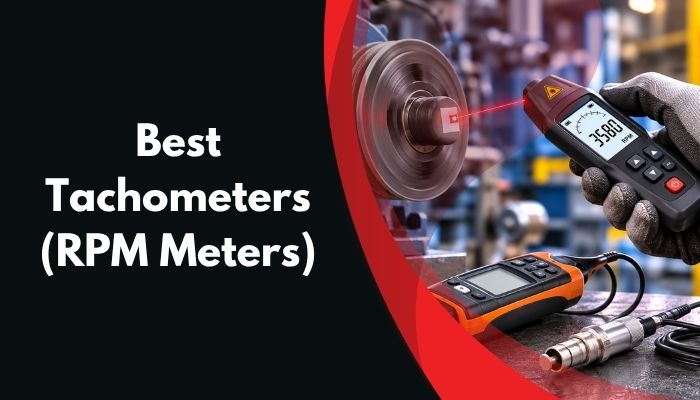
How to choose the right laser, optical, contact, or combination tachometer for accurate RPM, rotational-speed, surface-speed, and production-line measurements.
⚡ Quick Answer: Which Tachometer Should You Buy?
The best tachometer depends on access, machine speed, safety conditions, and whether you need rotational RPM only or linear surface speed as well.
- Choose a non-contact laser or optical tachometer for high-speed, hot, guarded, moving, or difficult-to-reach shafts.
- Choose a contact tachometer for accessible, lower-risk rotating parts and for direct surface-speed measurement on conveyors, rollers, belts, and web processes.
- Choose a combination contact/non-contact tachometer if one instrument must cover diverse maintenance tasks across a plant.
- For vibration analysis and predictive maintenance, always record the actual running RPM; it gives essential context to vibration frequencies and machine-condition trends.
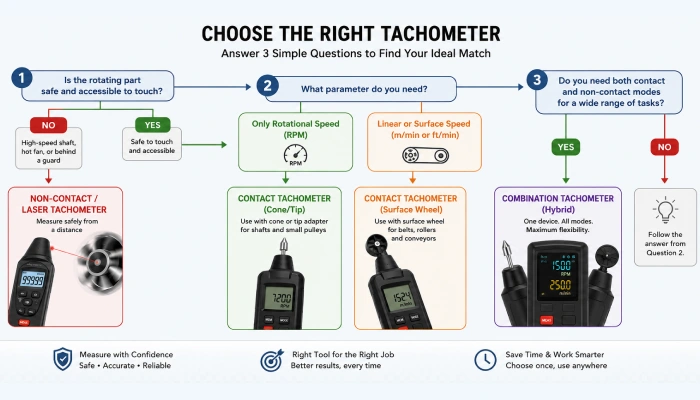
A tachometer, also called an RPM meter, rev counter, or rotational speed meter, measures how fast a shaft, wheel, motor, fan, roller, or spindle rotates. In industrial maintenance, a tachometer is much more than a simple speed-reading tool. It helps technicians verify commissioning settings, compare actual operating speed with nameplate values, detect belt slip, confirm drive ratios, support energy-efficiency checks, and interpret vibration data with greater confidence.
This expert buyer’s guide explains the technology behind laser tachometers, optical tachometers, contact tachometers, and combination RPM meters. It also covers the specifications that genuinely matter, practical measurement methods, common mistakes, use-case recommendations, and the role of rotational speed in a modern condition-monitoring programme.
What Does a Tachometer Measure?
A tachometer primarily measures rotational speed, normally expressed in revolutions per minute (RPM). Depending on the instrument design and accessories, a digital tachometer may also measure:
Rotational Speed
The speed of a shaft, motor, fan, spindle, pulley, wheel, or roller in RPM.
Surface Speed
The linear speed of moving materials or surfaces, typically in m/min, m/s, ft/min, or ft/s.
Total Count
The number of rotations, useful for cycle counting, length calculations, and production monitoring.
For example, a maintenance technician may use a laser RPM meter to verify a fan motor’s running speed, while a production engineer may use a contact tachometer with a measuring wheel to check the linear speed of a conveyor belt or packaging web.
Why Rotational Speed Matters
RPM Is a Fundamental Machine-Health Variable
A fan, pump, motor, gearbox, conveyor, or spindle operating at the wrong speed can indicate a setup problem, electrical slip, mechanical load issue, incorrect variable-frequency-drive setting, belt wear, pulley mismatch, or process inefficiency.
Checking actual speed against the expected speed is one of the fastest and most informative inspections in industrial maintenance. A two-minute RPM measurement can reveal whether a machine is operating as intended before a technician spends time on deeper mechanical or electrical investigation.
Typical Tachometer Applications
- Motor, fan, blower, and pump commissioning
- HVAC fan-speed verification and air-handling-unit maintenance
- Machine-tool spindle-speed checks
- Conveyor, roller, belt, and web-process speed control
- Gearbox, pulley, and belt-drive ratio verification
- Automotive engine, workshop, and rotating-equipment checks
- Production-line setup, cycle monitoring, and quality control
- Vibration analysis and condition-monitoring programmes
Contact vs. Non-Contact Tachometers
The most important buying decision is whether the RPM meter needs to touch the rotating object. This affects safety, measurement capability, suitable applications, accessories, and operating technique.
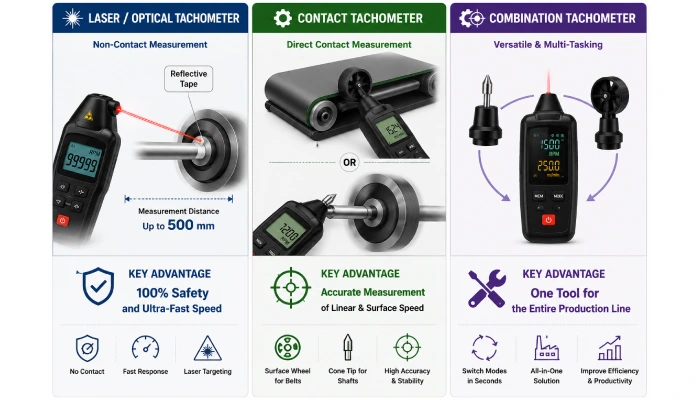
1. Optical / Laser Non-Contact Tachometers
A non-contact tachometer directs a light beam—often described as laser or optical—towards a reflective mark placed on the rotating target. Each pass of the reflective tape generates a pulse, and the tachometer converts those pulses into RPM.
Best for: high-speed fans, guarded motors, hot shafts, moving parts, hard-to-reach locations, rotating equipment where physical contact would be unsafe, and quick inspections without stopping the machine.
2. Contact Tachometers
A contact tachometer uses a rotating tip, cone, or measuring wheel placed against the shaft or moving surface. It is especially useful when a direct measurement method is practical and when the technician needs to measure linear surface speed.
Best for: accessible shafts, low-to-moderate-speed equipment, conveyor belts, rollers, web processes, textile machinery, packaging lines, and applications requiring m/min or ft/min readings.
3. Combination Contact / Non-Contact Tachometers
A combination tachometer offers both optical and contact modes in one instrument. It is usually the most flexible choice for maintenance teams working across different asset types. One tool can verify motor RPM from a safe distance, then measure conveyor surface speed with a contact wheel.
Tachometer Comparison Table: Which Technology Is Right?
| Feature | Optical / Laser Tachometer | Contact Tachometer | Combination Tachometer |
|---|---|---|---|
| Measurement Method | Reflective mark and light pulse detection | Direct contact using a tip, cone, or wheel | Both optical and contact measurement |
| Best Safety Profile | Excellent for hazardous or inaccessible rotating parts | Requires safe physical access to the target | Depends on the selected mode |
| Surface-Speed Measurement | Usually not direct | Excellent with a suitable measuring wheel | Available in contact mode |
| Main Limitation | Needs a clean reflective target and suitable line of sight | Can slip if the tip or wheel is not held correctly | Typically higher cost and more accessories |
| Ideal Applications | Motors, fans, blowers, shafts, spindles | Conveyors, rollers, belts, web processes | General industrial maintenance teams |
Key Tachometer Specifications to Compare Before Buying
A good tachometer is not simply the model with the largest RPM number on its display. The best RPM meter is one whose measurement range, accuracy, resolution, operating method, and accessories match your real equipment and working environment.
RPM Range
Select a measurement range that comfortably covers the lowest and highest speed you expect to measure. Avoid choosing a meter that only barely reaches the machine’s expected maximum RPM.
Accuracy
Accuracy determines how close the displayed result is to actual speed. For setup, commissioning, and diagnostic work, use an instrument with a clearly stated accuracy specification.
Resolution
Resolution is the smallest displayed change in speed. Fine resolution is valuable when comparing small changes in fan speed, motor speed, or controlled processes.
Detection Distance
For a laser or optical tachometer, confirm that the rated detection distance suits the available access and line of sight at your equipment.
Memory and Data Functions
Min/Max/Last readings, data hold, averaging, and memory storage make fieldwork more reliable when the display cannot be watched continuously.
Display and Ergonomics
A backlit LCD, strong contrast, one-hand operation, a stable grip, and clear function indicators are major advantages in plant environments.
Professional Buying Tip
Do not compare accuracy without comparing the stated measurement conditions. Optical accuracy can be affected by target quality, reflective tape placement, ambient light, and operating distance. Contact readings depend on correct alignment and avoiding wheel or tip slip.
How to Choose the Best Tachometer by Application
Motor and Fan Commissioning
For electric motors, HVAC fans, blowers, and pumps, a non-contact optical tachometer is often the preferred solution. It allows technicians to verify operating RPM without placing hands or contact accessories near a rotating shaft. Compare the measured speed with the motor nameplate, VFD setting, fan curve, or expected pulley ratio.
Conveyors, Rollers, and Web Processes
A contact tachometer with a surface-speed wheel is usually the practical choice for a conveyor belt, packaging line, textile web, cable line, paper process, or rotating roller. Instead of calculating speed manually from RPM and diameter, the tachometer can read linear speed directly when the correct wheel is used.
Machine Tool and Spindle Checks
For lathes, drills, milling machines, grinders, and other machine tools, use a non-contact RPM meter where safe access is limited or where contact could affect the operation. Accurate spindle RPM verification supports process consistency, tool-life management, and surface-finish control.
Belt-Driven and Geared Equipment
Do not assume that output speed equals the motor’s rated speed. In belt-driven and geared systems, a worn belt, pulley mismatch, incorrect gearbox ratio, or mechanical slip can change the final shaft RPM. Measuring both input and output speed helps detect issues before they reduce throughput or cause failure.
General Maintenance Departments
If technicians work on a mixed range of pumps, fans, motors, conveyors, and production equipment, a combination tachometer offers the broadest practical capability. The ability to switch between non-contact RPM measurement and contact surface-speed measurement reduces the need to carry separate instruments.
How to Take Accurate Tachometer Readings
Measurement Quality Depends on Technique
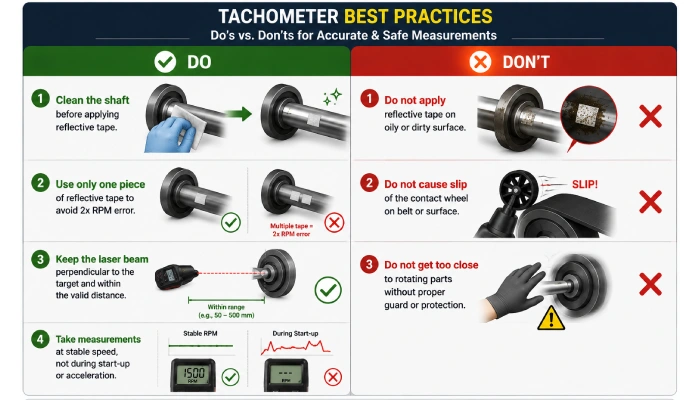
Even a high-quality RPM meter can produce unstable or misleading readings if reflective tape is poorly applied, the measuring angle is inconsistent, the target is outside the rated distance, or a contact wheel slips.
Best Practice for Optical / Laser Tachometers
- Stop and isolate the machine when it is safe and appropriate to apply reflective tape.
- Clean and degrease a small target area so the reflective mark adheres securely.
- Use one clear reflective mark unless the tachometer setup specifically accounts for multiple marks.
- Operate within the instrument’s rated detection distance.
- Aim steadily at the reflective mark and maintain a consistent angle.
- Allow the machine to reach stable operating speed before recording data.
- Take multiple readings and confirm that they agree before making a maintenance decision.
Best Practice for Contact Tachometers
- Only use contact measurement where physical access is safe and permitted by your site procedures.
- Choose the correct contact tip, cone, or surface-speed wheel for the application.
- Hold the instrument square to the rotating shaft or moving surface.
- Apply steady, controlled pressure—excessive pressure can create slip or disturb the measurement.
- Avoid measuring near unstable edges, damaged surfaces, or locations where the wheel cannot track smoothly.
- Repeat the reading to confirm repeatability.
RPM as a Diagnostic Clue in Condition Monitoring
An RPM meter is a valuable addition to a condition-monitoring toolkit because many mechanical and vibration phenomena are directly related to running speed. Accurate rotational-speed data helps convert a general observation—such as “the machine vibrates”—into a more focused technical diagnosis.
Connecting RPM to Vibration Data
Vibration signatures are often discussed in multiples of running speed. For example, a vibration component near 1× running speed may be associated with unbalance, while other patterns can indicate misalignment, looseness, belt-related issues, gear-mesh behaviour, or bearing-related frequencies. Exact shaft RPM provides the reference point needed to interpret these relationships more confidently.
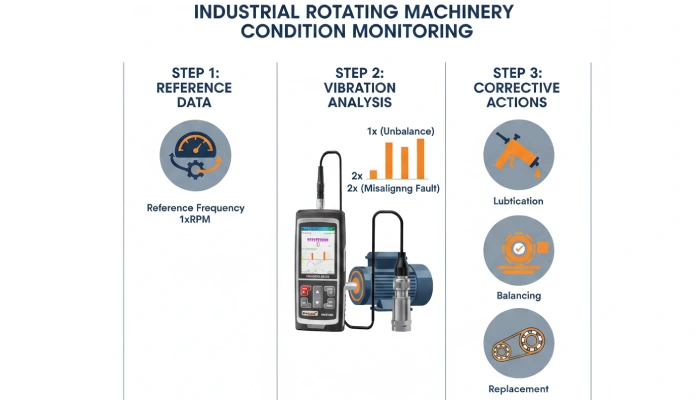
Maintenance workflow: Use a tachometer to confirm actual running speed, then compare that value with vibration trends from a suitable vibration meter. This combined approach supports more informed troubleshooting than either measurement alone.
For a complete maintenance workflow, a tachometer can be used alongside a MarMonix MVB 600 vibration meter or an MVB 200 vibration meter. The tachometer supplies the speed reference; the vibration meter helps assess the machine’s condition. Together, they help technicians investigate fans, motors, pumps, gearboxes, and other rotating assets more effectively.
Confirming Nameplate and Drive Performance
A motor or fan operating noticeably away from its expected speed deserves attention. Possible causes include incorrect drive programming, supply-frequency issues, motor slip, excessive mechanical load, a damaged belt, pulley wear, or an incorrect drive ratio. Measuring actual RPM is one of the quickest ways to confirm whether the asset is delivering expected performance.
Energy, Throughput, and Process Stability
Rotational speed affects both energy use and production output. Fans and pumps operating faster than required may consume unnecessary energy, while low conveyor speed or slow production rollers may reduce throughput. RPM measurement gives maintenance and production teams an objective value for setting, verifying, and improving process performance.
Common Tachometer Mistakes to Avoid
| Common Mistake | Why It Causes Problems | Better Practice |
|---|---|---|
| Measuring outside the optical distance rating | The sensor may miss pulses or produce unstable results. | Stay within the manufacturer’s specified detection range. |
| Dirty, loose, or damaged reflective tape | Poor reflection causes missed or inconsistent optical pulses. | Use a clean, securely bonded reflective mark. |
| Reading before speed stabilises | Startup and transient conditions do not represent normal operation. | Measure under stable, normal operating conditions. |
| Contact-tip or wheel slip | Slip produces incorrect RPM or surface-speed results. | Hold the tool squarely and use steady, controlled contact. |
| Ignoring safety access | Contact measurement near exposed rotating parts creates avoidable risk. | Use non-contact measurement whenever safe access is limited. |
Frequently Asked Questions About Tachometers
What is the difference between a tachometer and an RPM meter?
In most industrial contexts, they refer to the same type of instrument. A tachometer measures rotational speed, usually displayed in revolutions per minute (RPM). Some models also measure surface speed and total count.
Is an optical tachometer safer than a contact tachometer?
Yes, in most high-speed, hot, guarded, or difficult-to-access applications. An optical or laser tachometer measures RPM without touching the rotating component. Alw