
Best Video Borescopes in 2026: Inspection Camera Buyer’s Guide
Quick Answer: Which Borescope Do You Need in 2026?
The best video borescope depends on probe diameter (it must fit your access port), articulation (essential for navigating bends like engine valves), and documentation (recording turns findings into maintenance evidence).
Expert picks:
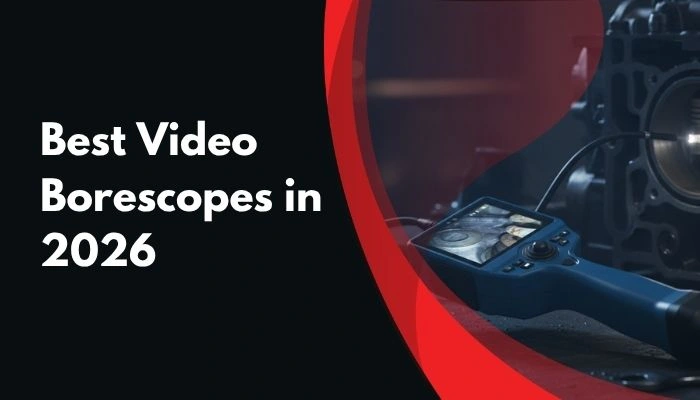
• MVS-500: Compact handheld articulating videoscope with a 6 mm IP67 probe and 5-inch IPS screen for short, tight access.
• MVS-600 Series: Modular standard for automotive & general maintenance (probes 1.0–8.0 mm).
• 700 Series: High-end field diagnostics with HD touch display and WiFi reporting.
• MDCS/MCDS Series: Heavy-duty sewer & pipeline inspection with pan-tilt-zoom cameras (40–60 m reach).
Ready to upgrade your inspection toolkit? Browse our full range of Video Borescopes or contact our engineering support team for a personalized recommendation based on your exact diameter and length requirements.
Best Video Borescopes & Pipe Inspection Systems
A high-quality video borescope is the ultimate time-saver in industrial maintenance. By letting you visualize engine cylinders, gearbox internals, or deep pipeline obstructions without disassembly, these devices turn a destructive, time-consuming job into a rapid, non-invasive inspection. But with varying probe diameters, sensor types, and software integration, choosing the right tool is critical.
1. Understanding the Core Mechanics
A borescope consists of a camera and a light source at the tip of a probe. The key differentiator in 2026 is no longer just “seeing” — it’s documentation. The industry has shifted from simple visual checks to digital forensics. Recording video and high-resolution stills transforms your findings from an “opinion” into actionable maintenance evidence.
2. The 2026 Comparison Table: Key Specifications
Having established the importance of documentation and modern inspection standards, it is time to move from theory to practice. The following comparison guide breaks down the critical 2026 benchmarks, helping you distinguish between a smart investment and an unnecessary expense.
| Feature | Why It Matters | Professional Tip |
|---|---|---|
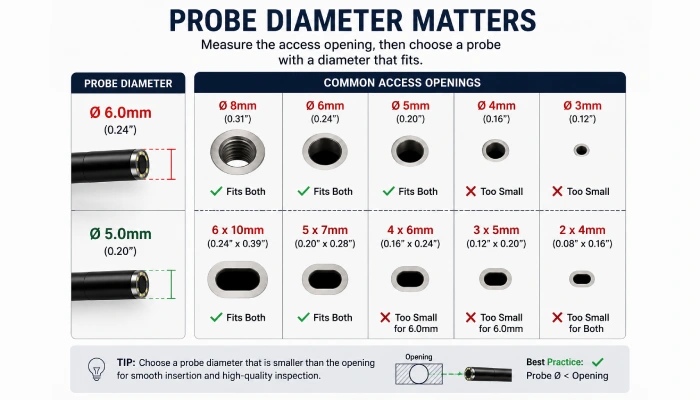
| Probe Diameter | Must fit your access port. | Measure the smallest entry point first — a 6 mm probe is useless in a 5 mm port. |
| Articulation | Steering the tip inside cavities. | Essential for engine valves and turbine blades; optional for straight pipes. |
| Illumination | Visibility in dark cavities. | Adjustable LED brightness prevents glare on polished metal. |
| Storage / Connectivity | Documentation & reporting. | Prioritize WiFi for instant report sharing in the field. |
| Depth of Field (DoF) | Sharpness at varying distances. | Wide DoF is critical for large tanks and HVAC ducts. |
3. MarMonix 2026 Product Family Breakdown
With these technical benchmarks in mind, you can now prioritize what matters most for your specific application. Next, we will explore how MarMonix product families are precision-engineered to address these exact challenges—ranging from intricate automotive maintenance to complex municipal infrastructure.
MarMonix MVS-600 Series: The Modular Standard
The MVS-600 is engineered for versatility. Its modular probe interface lets you swap probes of varying diameters — from a tiny 1.0 mm up to 8.0 mm — using a single host unit, eliminating the need to carry multiple scopes.
- Display: 3.5″ TFT LCD (640 × 480 pixels).
- Probe range: 1.0, 1.2, 2.0, 2.8, 4.0, 5.8, and 8.0 mm diameters; lengths 0.5 m to 10 m.
- Optics: Selectable field of view (80° / 90° / 100° / 120°) and multiple depth-of-field options.
- Articulation: Optional all-way mechanical articulation up to 360°, joystick/wheel controlled.
- Key advantages: IP67 waterproof probes, 10 brightness levels, 4× digital zoom, JPEG/AVI/MP4 capture, and up to 6 hours of continuous operation.
MarMonix 700 Series: Advanced Field Connectivity
The 700 Series shifts focus to operator efficiency. A 5.1-inch HD touch display combines the usability of modern mobile devices with rugged IP67 construction, ideal for high-stakes maintenance environments.
- Connectivity: Built-in WiFi for real-time reporting, plus Type-C, USB, HDMI, and 3.5 mm audio ports.
- Probe range: 1.2 mm (712) to 8.0 mm (780); articulated from 1–5 m, non-articulated to 15 m on the 8 mm model.
- Camera options: Forward, Side, and Dual-View (forward + side) for comprehensive pipe and cavity-wall inspection.
- Optics: 90° / 100° viewing angle, 5 mm–150 mm depth of field, 3× digital zoom, adjustable LED brightness.
- Key advantages: Touch + physical buttons (glove-friendly), image rotation, USB flash support up to 128 GB.
MarMonix MDCS Series: Heavy-Duty Pipeline Inspection
For municipal and industrial plumbing, handheld probes fall short. The MDCS series is an all-in-one, suitcase-style system with a 10.1-inch HD monitor (1024 × 600) and specialized pan-tilt-zoom camera heads for 40 m or 60 m reach. For longer runs, the MDCS dual-view rotating inspection camera system extends reach to 100–300 m.
- MDCS-40M: 40 m cable with a 40 mm (1½”) self-leveling waterproof color camera head.
- MDCS-60M: 60 m cable with a 60 mm (2.6″) pan-tilt & 10× zoom camera head.
- Key advantages: Sun visor for outdoor use, image mirror/flip, wireless keyboard option, and an integrated waterproof ABS carry case with rotatable reel.
4. Side-by-Side Family Comparison
Navigating the options between these series might seem complex at first. To simplify your decision-making process and provide a clearer overview, we have summarized their core features in the side-by-side table below.
| Series | Display | Probe / Camera | Reach | Best For |
|---|---|---|---|---|
| MVS-600 | 3.5″ LCD | 1.0 – 8.0 mm | 0.5 – 10 m | Automotive, general maintenance |
| 700 Series | 5.1″ HD Touch | 1.2 – 8.0 mm | 1 – 15 m | High-end field diagnostics |
| MDCS / MCDS | 10.1″ HD | 40 mm / 60 mm PTZ | 40 / 60 m | Sewer & pipeline inspection |
5. Matching the Tool to Your Application
Even with the most advanced inspection technology, field challenges are inevitable. Below, we highlight the most common pitfalls that technicians encounter during initial inspections; knowing how to avoid them is the key to maximizing the lifespan of your equipment.
Automotive & Machinery
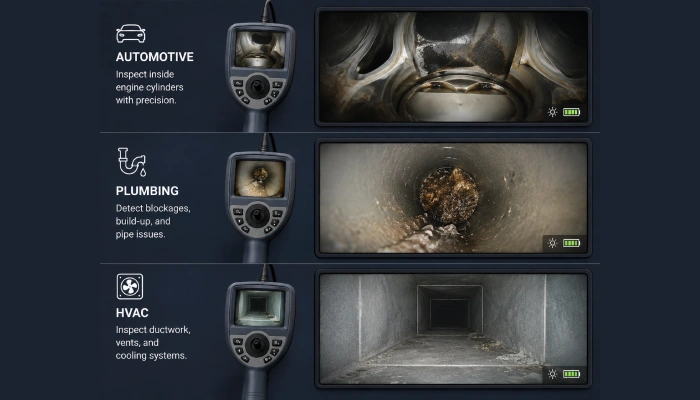
Prioritize slim, multi-way articulating probes. When inspecting cylinders, you must navigate around obstacles to reach the valve seats. A rigid probe will fail here — you need the precision of a steerable tip (a core strength of the MVS-600 and 700 Series articulated models, or the compact 6 mm MVS-500 articulating videoscope for short-reach work).
Plumbing & Drainage
Forget standard handheld probes. You need a push-rod system with durability and waterproofing as top priorities. For underground lines, a self-leveling camera head and long cable reach (as found in the MDCS series) are essential to pinpoint the exact location of a blockage.
HVAC & Manufacturing
Prioritize resolution and Depth of Field (DoF). In wide ducts or large tanks, a wide DoF keeps both the near surface and the distant structure sharp and focused — which is why adjustable DoF options matter more than raw megapixels.
6. Common Inspection Mistakes to Avoid
- Ignoring the access point: Never buy a borescope without measuring the port diameter first.
- Skipping documentation: If you don’t record the inspection, it didn’t happen. Always opt for on-board storage.
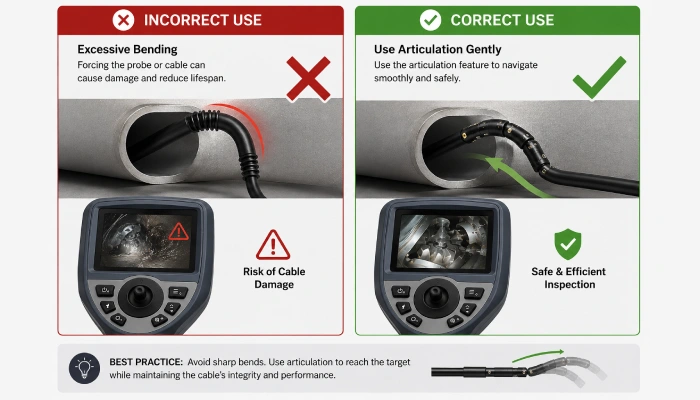
- Forcing the probe: If you feel resistance in a bend, stop. Forcing a probe causes kinking and permanently damages the fiber optics.
- Confusing display resolution with camera resolution: A high-res screen does not guarantee a high-res sensor — verify the actual imaging specs separately.
Frequently Asked Questions (FAQ)
Q: Do I really need articulation?
A: Yes, if you’re inspecting components that require “looking around” a corner (like engine valves or turbine blades). For straight-through pipe inspection, you can save budget by choosing a non-articulating system.
Q: Can I use these cameras in fuel or oil?
A: Only if the probe is IP-rated for liquid immersion. Always check the datasheet for the specific IP rating before submerging the camera in oils or chemicals.
Q: What’s the difference between the MVS-600 and 700 Series?
A: The MVS-600 is a modular system focused on probe flexibility (swapping diameters on one host). The 700 Series adds a larger HD touch display, built-in WiFi, and dual-view camera options — making it better suited for high-end field reporting.