
Description
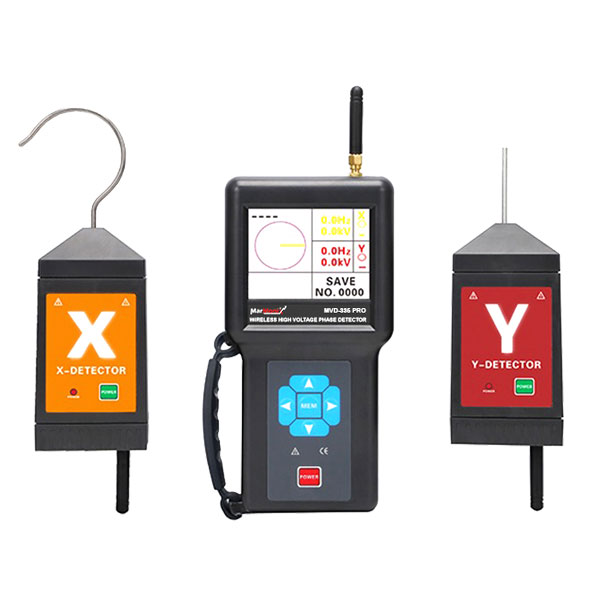
The Marmonix MVD-335 wireless HV phase detector checks phase, frequency, phase sequence and electrical presence from 200 V to 220 kV over a wireless link of up to 30 m between host and detector. It supports contact phasing on lower-voltage or insulated conductors and non-contact electric-field phasing when bare wire exceeds 35 kV, with a 3.5-inch colour display and 9999-set memory. Browse all Marmonix phase detectors, or compare the MVD-335 PRO wireless phase detector for a wider voltage and longer wireless range.
Wireless High Voltage Phase Detector MVD-335
wireless high-voltage phase detector is designed specially for the high-voltage phase detection, breaking the traditional phase voltage level limit, can detect phase at ultra low voltage, fully automated from 200V ~ 220kV (such as 400V, 10kV, 35kV, 66kV, 110kV, 220kV), without the need to purchase multiple sets of phase meter according to the voltage level, saving cost and reducing carrying time.
For the phase detection of the high-voltage line (when the voltage exceeds 400V), the detector’s metal hook can be gradually close to the wire, inducing the electric field signal to complete the nuclear phase, without direct contact with high-voltage wire, safe! When the bare wire voltage exceeds 35 kV, a non-contact phase detection must be used.
The phase detector also has functions such as phase test, frequency test, phase sequence test, inspection, transformer group judgment etc.
Wireless High Voltage Phase Detector MVD-335 Features
The MVD-335 provides:
- High-voltage phase detect, frequency, phase, phase sequence, electrical inspection.
- Phase voltage: 200V~220kV, Test phase: 0.0 °~360.0 °, Test Frequency: 45.0Hz ~65.0Hz.
- Voice prompts, wireless transmission, color display, vector diagram instructions, phase indication, data upload function.
Wireless High Voltage Phase Detector MVD-335 Specifications:
| Functions | High-voltage phase detect, frequency, phase, phase sequence, electrical inspection. |
| Power Supply | Host: DC9V,6pcs 5 alkaline batteries,Detector:Zinc – manganese dry batteries 6F22、9V |
| Phase Detect Modes | 1.Contact Phase Detect: can contact wire which is below 35KV(bare wire)or 220KV(With insulation Cover)
2.Non-Contact Phase Detect: conduct non-contact testing when bare wire exceeds 35KV,detect Probe close to the wire gradually. |
| Wireless Distance | 30M |
| Phase characterization | 1.In Phase:-25°~25°
2.Out of Phase: 95°~145° and 215°~265 |
| Phase detect Voltage | 200V~220kV |
| Phase Range | 0.0°~360.0°;Accuracy:≤±12°;Definition:0.1° |
| Frequency Range | 45.0Hz~65.0Hz;Accuracy:≤±2Hz;Definition:0.1Hz |
| Transmission frequency | 433MHz、315MHz |
| LCD | 3.5inch Color Display;Display Field:71mm×53mm |
| Phase indication | Phasor diagram and digital display |
| Power indication | Green indication light |
| Working indication | Sound and Light Indicator,red double flash indicator and “beep – beep – beep” beep sound |
| Display Speed | 2Times/Second |
| Data Storage | 9999Sets (Replace the battery without losing data) |
| LCD backlight | Adjustable brightness, to adapt to different environments |
| Automatic shut-down | Turn on the instrument for about 5 minutes |
| Battery Voltage | When the battery voltage dropped to 7.2V ± 0.1V, “the battery voltage is low” symbol display, to remind the replacement of the battery, the measured data is also accurate. |
| Rated current | Detector:30mA max;Host:150mA max |
| Weight | Host:950g(includes Batteries),Packing and Insulation Rod: 3KG |
| Size | Host:195mm×100mm×45mm;Detector:290mm×250mm×80mm |
| Insulation Rod Length | Max Diameter:Φ38mm;Length:Pull Back 1050mm;Extech 4850mm |
| Insulation Test | Insulated rods at both ends after drawing: AC 220 kV / rms
Host, detector: AC3700V / rms (exposed metal and plastic housing) |
| Outside Interference | No special strong electromagnetic field; no 433MHz, 315MHz frequency interference |
| Working Temperature and Humidity | -10℃~40℃; below 80%rh |
| Storage Temperature and Humidity | -20℃~60℃; below 70%rh |
| Degree of protection | IP63 |
| Safety Protocol | GB13398-92、GB311.1-311.6-8、3DL408-91,《General technical requirements for portable nuclear power apparatus for use in 1kV ~ 35kV portable power plants DL/T971-2005》,IEC61481-A2;2004;IEC 61243-1 ed.2:2003 |
| Accessories | Host:1set, Detector: 2 pieces, Probe: 2pcs, Probe Hook: 2pcs,insulation rod: 2pcs, 1 piece of software CD, 1 piece of USB data cable, 6 pieces of LR6 battery, 2 pieces of 6F22 battery, 1 inspection line, Toolkit 1 piece |
Questions about the MVD-335 wireless HV phase detector
When should I use contact vs non-contact mode on the MVD-335?
Use contact mode on the MVD-335 for bare conductors below 35 kV or insulated conductors up to 220 kV, and non-contact mode when bare wire exceeds 35 kV by bringing the probe close to the line. Both modes share the same 200 V–220 kV phase-detect voltage window.
What does the MVD-335 display and store?
The MVD-335 shows phase on a 3.5-inch colour screen with a phasor diagram and digits, covers 0.0°–360.0° phase and 45.0–65.0 Hz frequency, and stores up to 9999 sets that stay when you change batteries. Sound and light indicators confirm activity.
MVD-335 or MVD-335 PRO: which should I choose?
Choose the MVD-335 for 200 V–220 kV work with up to 30 m wireless range, and the MVD-335 PRO when you need the wider published voltage window and longer wireless distance on that sibling page. Confirm the voltage class and span of your lines when you ask for a quote.
Case study: phasing check before connecting high-voltage circuits
In a typical switching job, before two supplies or line sections are connected, the crew must confirm that the phases match, as connecting out of phase can cause a serious fault.
A wireless high-voltage phase detector uses two units placed on the conductors being compared, linked by radio to a host. On lower-voltage or insulated lines it phases by contact, and on bare lines above 35 kV it phases without contact by sensing the electric field. It also checks frequency and phase sequence.
The crew tests each pair of conductors from a safe distance, reads the phase result on the host display, and stores it in memory before closing the connection.
Downloads
Downloads

Reviews (0)

Reviews
There are no reviews yet.