
Description
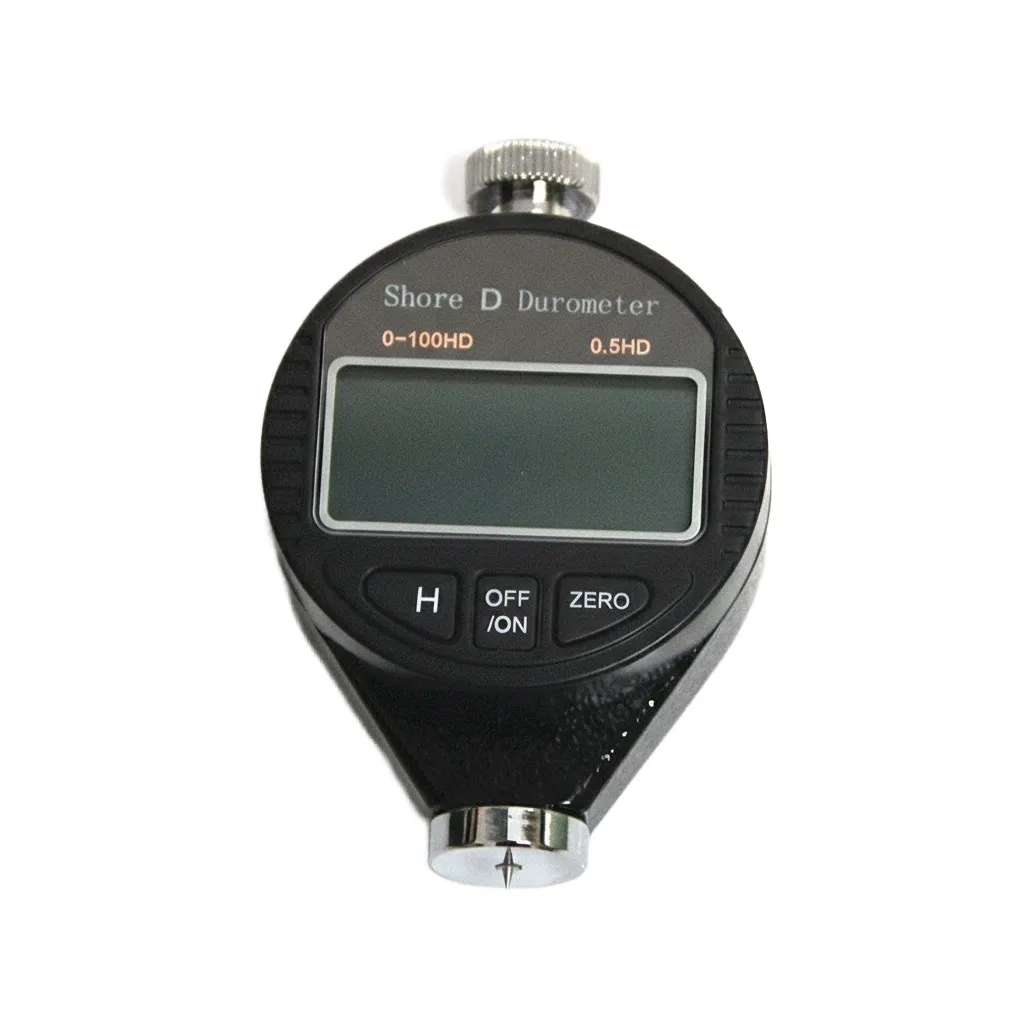
The Marmonix MDS-100D digital Shore D durometer measures hard rubber, rigid plastics, resins, epoxies and plexiglass from 0 to 100 HD with 0.1 Shore resolution and ±1 Shore accuracy. It uses a 30° conical indenter and an 8 mm pressure foot, and it runs on one 9 V battery in a 200 g body. It is listed for ASTM D2240 and ISO 48-4 (formerly ISO 7619-1). Browse all Marmonix hardness testers, or see the MDS-100A Shore A durometer when the material is soft rubber or an elastomer.
The MarMonix MDS-100D is a professional-grade, high-precision instrument engineered specifically for the hardness testing of rigid materials. Designed to operate on the Shore D scale, this digital durometer is the essential tool for quality control in industries working with hard rubber, rigid plastics, resins, epoxies, and plexiglass.
Unlike traditional analog gauges, the MDS-100D features a clear digital LCD that eliminates operator subjectivity and parallax errors. Its integrated probe and pocket-sized design make it highly portable for on-site material inspections, while its internal calibration features ensure it remains a reliable reference for laboratory R&D.
Why Choose the MDS-100D?
Hardness testing is a critical step in certifying material quality and ensuring proper curing of coatings and polymers. The MDS-100D uses a standardized 30° conical point indenter to measure the resistance of a material to penetration. This provides immediate feedback on whether a material meets engineering specifications or if a production batch has been correctly processed.
MarMonix MDS-100D Quick Spec Highlights
Key MDS-100D specifications at a glance:
-
Hardness Scale: Shore D (specifically for rigid materials like hard rubber and plastics).
-
Measuring Range: 0–100D with a high-resolution 0.1 Shore digital increment.
-
Accuracy: Guaranteed accuracy of $\pm1$ Shore for precise quality audits.
-
Standards Compliance: Fully compliant with international standards ASTM D2240 and ISO 7619-1.
-
Operating Temperature: Reliable performance in environments ranging from 0°C to +50°C.
MarMonix MDS 100D Key Features
What the MDS-100D gives you on site:
-
Advanced Digital Display: Large LCD screen for instant, error-free reading of hardness values, including average and peak results.
-
Data Hold Function: Allows the user to “freeze” a measurement on the screen for easier logging and reporting during field use.
-
Smart Power Management: Integrated auto power-off function helps preserve the life of the included 9V battery.
-
Professional Reliability: Built-in calibration features allow for routine accuracy checks to maintain compliance with ISO 9001 facility requirements.
-
Ergonomic Portability: Lightweight (200 g) and compact, designed for one-handed operation during on-site inspections.
MarMonix MDS100D Technical Specification
| Parameter | Details |
| Model | MDS-100D |
| Measurement Scale | Shore D |
| Measuring Range | 0–100D |
| Display Type | Digital LCD |
| Accuracy | $\pm1$ Shore |
| Resolution | 0.1 Shore |
| Pressure Foot Diameter | 8 mm |
| Battery | 1 × 9V Battery (Included) |
| Operating Temperature | 0°C to +50°C |
| Standards | ASTM D2240, ISO 7619-1 |
| Dimensions | 160 × 60 × 30 mm |
| Weight | 200 g |
How Shore D durometers are used on rigid plastics and hard rubber
In a typical incoming inspection or production check, a QC team needs to confirm that a rigid plastic part, resin casting or hard rubber component has reached its specified hardness without cutting a test piece from it.
A Shore D durometer presses a sharp cone into the surface under a defined spring force and shows the indentation hardness on a 0–100 scale. ISO 48-4 assigns the D scale to rubbers in the high-hardness range, and ASTM D2240 covers durometer hardness of elastomers, cellular materials and some plastics. For plastics and ebonite, ISO 868 specifies the Shore A and Shore D durometer method. ASTM D2240 also notes that durometer readings below 20 or above 90 are not considered reliable, so the scale is chosen so that normal readings fall inside that band.
In a typical check, the inspector holds the durometer vertical, presses the foot fully onto a flat area, freezes the value with Data Hold, and repeats at several spots before comparing the average with the drawing or material sheet. For softer materials measured on the A scale, the MTS-B-A7 Shore A test block set checks that a Shore A durometer still reads correctly.
Questions about the MDS-100D Shore D durometer
What materials is the MDS-100D for?
The MDS-100D is for hard materials on the Shore D scale: hard rubber, rigid plastics, resins, epoxies and plexiglass. Soft rubber, elastomers and leather belong on a Shore A durometer instead.
How accurate is the MDS-100D?
The MDS-100D is specified at ±1 Shore accuracy with 0.1 Shore resolution over 0–100 HD, shown on a digital LCD with Data Hold and auto power-off. It runs on one 9 V battery and works from 0 °C to +50 °C.
MDS-100D or MDS-100A: which should I choose?
Choose the MDS-100D when the sample is rigid plastic, resin or hard rubber, and the MDS-100A when it is soft rubber or an elastomer on the Shore A scale. ASTM D2240 treats readings above 90 as not reliable, so a part that reads that high on Shore A is better checked on the MDS-100D.
Downloads
Downloads

Reviews (0)



Reviews
There are no reviews yet.