
Description
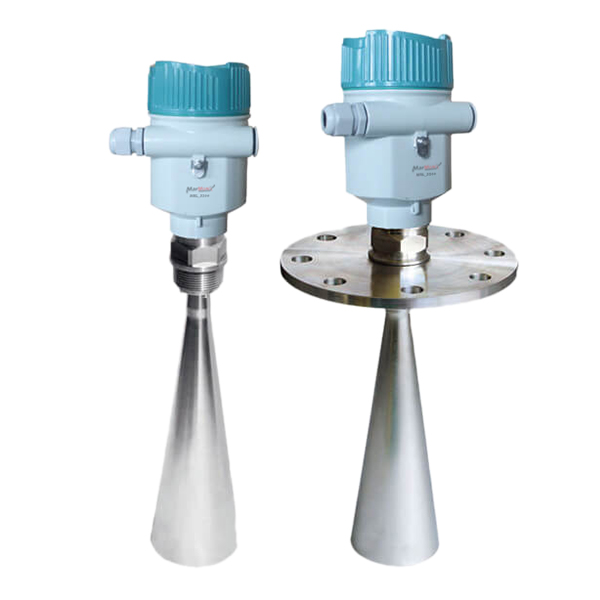
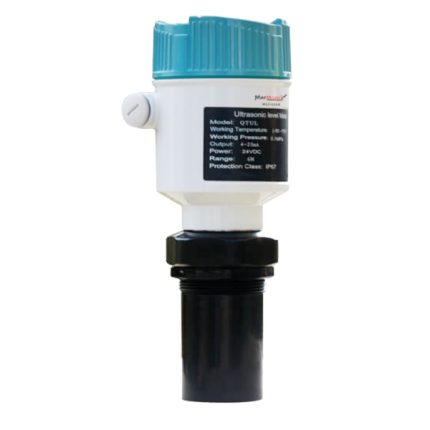
The Marmonix MRL-3200 radar level meter is a 26 GHz non-contact transmitter for solid materials and heavy dust, measuring up to 70 m with ±15 mm precision at process temperatures from -40 to 250 ℃. It outputs 4–20 mA/HART or RS485/Modbus, has an aluminium IP67 housing with a universal flange and is rated Exia IIC T6 Ga. Browse all Marmonix level transmitters, or compare the MRL-3500 for liquids.
Guided-Wave Radar for Level Measurement MRL-3200
This series of radar level meter Marmonix MRL-3200 adopted 26G high frequency radar sensor, the maximum measurement range can reach up to 70 meters. Antenna is optimized further processing, the new fast microprocessors have higher speed and efficiency can be done signal analysis, the instrumentation can be used for reactor, solid silo and very complex measurement environment.
Radar level transmitter antenna microwave pulse is narrow, the downward transmission antenna. Microwave exposure to the medium surface is reflected back again by the antenna system receives, sends the signal to the electronic circuit automatically converted into level signals (because the microwave propagation speed, electromagnetic wave to reach the target and the reflected back to the receiver this time is almost instantaneous).
Guided-Wave Radar for Level Measurement MRL-3200 Features
Key features of the MRL-3200 include:
- Small antenna size, easy to install; Non-contact radar, no wear, no pollution.
- Almost no corrosion, bubble effect; almost not affected by water vapor in the atmosphere, the temperature and pressure changes.
- Serious dust environment on the high level meter work has little effect.
- A shorter wavelength, the reflection of solid surface inclination is better.
- Beam angle is small, the energy is concentrated, can enhance the ability of echo and to avoid interference.
- The measuring range is smaller, for a measurement will yield good results.
- High signal-to-noise ratio, the level fluctuation state can obtain better performance.
- High frequency, measurement of solid and low dielectric constant of the best choice.
Guided-Wave Radar for Level Measurement MRL-3200 Specifications:
| Suitable for Medium | Solid material, Strong dust |
| Explosion-proof Grade | Exia IIC T6 Ga |
| Measuring Range | 70 meters |
| Frequency | 26 GHz |
| Temperature: | -40℃ ~ 250℃ |
| Measurement Precision | ±15mm |
| Process Pressure | -0.1 ~ 0.1MPa |
| The signal Output | (4 ~ 20) mA/HART (Two wire/Four)RS485/Modbus |
| The Scene Display | Four digital LCD |
| Shell | Aluminum |
| Connection | Universal Flange |
| Protection Grade | IP67 |
Questions about the MRL-3200 radar level meter
Does the MRL-3200 touch the material it measures?
No, the MRL-3200 is a non-contact radar: its datasheet describes a narrow 26 GHz microwave pulse sent down from a horn antenna and reflected back by the material surface, so nothing sits in the medium. That is why it suits dusty silos and reactors with solid material.
Which connections and antennas are available for the MRL-3200?
The MRL-3200 datasheet lists G1½″A or 1½″ NPT threads and DN80–DN250 stainless steel 304 flanges (also with a nickel-plated carbon-steel cardan joint), with Φ46, Φ76 or Φ96 mm horn antennas and Viton or Kalrez seals. Electronics are 24 V DC two-wire 4–20 mA (with or without HART), 220 V AC four-wire 4–20 mA or RS485/Modbus.
MRL-3200 or MRL-3500: which should I choose?
Choose the MRL-3200 for solids and heavy dust over long distances, up to 70 m at ±15 mm and up to 250 ℃, and the MRL-3500 for hygienic liquid storage or corrosive containers, up to 20 m at ±3 mm and up to 150 ℃. Both use 26 GHz radar, 4–20 mA/HART or RS485/Modbus output, an aluminium IP67 housing and an Exia IIC T6 Ga rating.
Downloads
Downloads

Reviews (0)
Reviews
There are no reviews yet.