
Best Lux Meters (Light Meters) in 2026: Buyer’s Guide
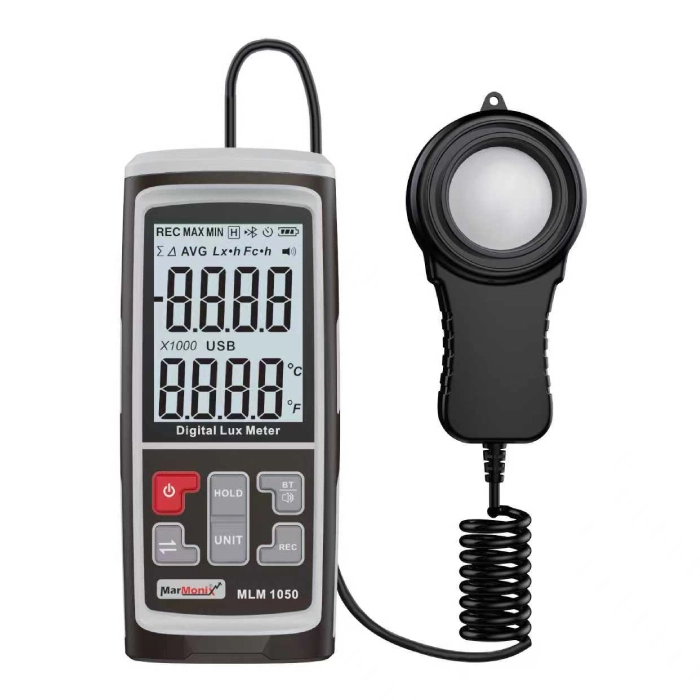
A lux meter (light meter) measures how much visible light actually falls on a surface, turning a subjective impression of “bright enough” into a number you can document and defend. From workplace safety and lighting compliance to photography, retail, and horticulture, the right meter gives you repeatable, traceable readings. This 2026 guide explains how lux meters work, the specifications that separate a serious instrument from a toy, and where the Marmonix lux meter fits.
The best meter for you depends on your required accuracy, light sources, and whether you need to log data over time. We break each down and connect them to real applications below.
What a Lux Meter Measures
A lux meter reads illuminance — the luminous flux landing on a unit area — in lux (metric) or foot-candles (imperial). It answers a practical question: is there enough light here for the task, the standard, or the camera?
Illuminance versus brightness
Illuminance is about light arriving at a surface, not how bright a lamp appears. That distinction is why a lux meter, not your eye, is the correct tool for compliance. The human eye adapts constantly and is a poor absolute judge of light level.
Where lux meters are used
Office and factory lighting audits, school and hospital compliance, film and photography, museum conservation, and plant-growth lighting all depend on measured illuminance rather than guesswork.
Key Specifications to Compare
Sensor type and spectral response
A quality meter uses a silicon photodiode filtered to match the photopic (Vλ) response of the human eye, so it weights colours the way our vision does. A meter without proper spectral correction can read badly wrong under LED or sodium lighting.
Cosine correction
Cosine correction is not a luxury. Light arriving at an angle must be weighted correctly, and a properly cosine-corrected diffuser ensures the meter reads accurately when illumination comes from the side, not just straight on. Without it, field readings can be substantially off.
Range and resolution
The meter must span everything from dim emergency lighting (a few lux) to bright sunlight (over 100,000 lux). Good resolution at low levels matters for emergency and conservation work.
Accuracy and calibration
Look for a stated accuracy figure and a calibration certificate; traceable calibration is what makes your readings defensible in an audit.
Display, hold, and logging
A clear backlit display, data hold, min/max capture, and optional data logging turn one-off readings into a documented survey.
Lighting Standards and Targets
Many tasks have recommended illuminance levels — for example, general office work, detailed assembly, and corridors each have their own targets under standards such as EN 12464-1. A lux meter lets you prove you meet the recommended level rather than simply asserting it, which matters for safety officers, facilities managers, and consultants alike.
How to Choose by Use Case
Workplace and compliance surveys
Prioritise spectral and cosine correction, traceable calibration, and logging so your survey stands up to scrutiny.
Photography and film
Fast response, foot-candle units, and good low-light resolution help you set consistent lighting.
Horticulture and retail
Wide range and reliable LED performance matter most for plant lighting and display work.
The Marmonix Lux Meter
For accurate, repeatable illuminance measurement, the Marmonix MLM 1050 Lux Meter combines a corrected sensor with a clear readout for workplace, educational, and general lighting surveys. Browse related instruments in the lux meters category. Confirm the range and resolution suit both your dimmest and brightest measurement points.
Getting the most from it
Used with consistent technique, the MLM 1050 lets you build a grid of readings across a room to map uniformity, not just a single spot value — which is exactly what lighting standards expect.
How to Take Accurate Readings
Hold the sensor flat at the working plane, keep your own shadow off it, and let the reading settle. Allow lamps to stabilise — many LED and discharge sources change output for several minutes after switch-on — and take a grid of points to capture uniformity. One reading in the middle of a room rarely tells the whole story.
Grid Surveys and Uniformity
Compliance is rarely about a single bright spot — it is about whether a whole space is adequately and evenly lit.
Why uniformity matters
A room can hit its target illuminance directly under each fitting yet fail in the gaps between them. Uniformity — the ratio of minimum to average illuminance — describes how consistent the lighting is, and many standards set a minimum value. Poor uniformity causes eye strain even when the average looks fine on paper.
How to run a grid
Divide the area into a regular grid, take a reading at the centre of each cell at the working plane, and calculate the average and minimum. The grid turns a handful of spot checks into a defensible survey that shows both the level and the evenness of the lighting across the entire space.
Common Mistakes to Avoid
Shadowing the sensor, measuring before lamps stabilise, holding the sensor at the wrong plane, and using an uncorrected meter under LED lighting are the frequent errors. Technique matters as much as the instrument; a good meter used carelessly still produces misleading numbers.
Frequently Asked Questions
Lux or foot-candles — which should I use?
They measure the same thing in different units (1 foot-candle ≈ 10.76 lux). Use whichever your standard or client specifies; good meters switch between them.
Why does my phone app disagree with a lux meter?
Phone sensors lack proper spectral and cosine correction and are not calibrated, so they are fine for rough guidance but not for compliance.
How often should a lux meter be calibrated?
Annually is typical for professional use, or per your quality system, to keep readings traceable and defensible.
Does light colour affect the reading?
It can if the meter is poorly corrected. A photopically corrected sensor handles different light colours far more accurately.
Related Buyer’s Guides
Explore our Sound Level Meters guide, the Thermal Imaging Cameras guide, or browse every model in the lux meters category.